DIN 933, 934 e 125: characteristics, differences, and applications of the main bolting standards
In the fastener industry, the pursuit of quality and standardization has always been a priority. Over time, the need to define shared, clear, and replicable technical parameters has led to the creation of regulatory bodies capable of establishing a common language among manufacturers, distributors, and users worldwide.
Acronyms such as DIN, ISO, and UNI represent just that: a system of technical rules that guarantees dimensional uniformity, mechanical performance, and interchangeability of components.
In this article, we will focus on DIN nomenclature, exploring the origins of the institute from which it takes its name and analyzing some of the main standards applied to screws and bolts.
DIN: from its origins to international standardization
The German Institute for Standardization (DIN) was founded in 1917 with the aim of defining technical standards for German industry. Originally, the organization was called Normenausschuss der deutschen Industrie (NADI); in 1975, it took on its current name, Deutsches Institut für Normung. Today, “DIN” refers to both the institute and the set of technical standards it issues.
In 1943, the Berlin offices were destroyed during an air raid, but operations resumed as early as 1946. A key milestone came in 1951, when DIN joined the International Organization for Standardization (ISO), becoming the national standards body for Germany. In 1961, it was also one of the founding members of the European Committee for Standardization (CEN).
In 1975, an agreement with the German federal government officially established its role as the national standards body. In the following years, DIN expanded its international presence, initiating collaborations with other standardization bodies and contributing to the development of the European regulatory system.
Starting in the 1990s, the institute strengthened its global role, promoting a culture of standardization through initiatives, awards, and collaborations with the academic world. In 2017, it celebrated its centenary, confirming its central role in the international technical standardization landscape.
DIN and ISO standards, the difference
In the German market, and subsequently in the international market, DIN standards have been an essential reference point for the production and marketing of screws and bolts for many decades. However, with the progressive development of global trade, many of these standards have been harmonized or replaced by the corresponding ISO standards, with the aim of creating a shared technical standard worldwide. The main differences between DIN and ISO do not concern the function of the product—which remains essentially the same—but certain dimensional and tolerance aspects. In some cases, the following may vary:
dimensional tolerances
the height of the head or nut
the size of the wrench
the available length ranges
certain specifications related to the strength class
ISO standards were created precisely to promote greater international interchangeability, minimizing technical differences between countries and facilitating trade and integration into global supply chains. However, in the fastener and bolt industry, DIN standards continue to be widely used and in demand, especially in Europe, where they are still an established and recognized standard. Among the best known and most widely used DIN standards are: DIN 933, DIN 934, and DIN 125. Let's now take a closer look at their characteristics and applications.
Hexagon head screw with fully threaded shank: DIN 933
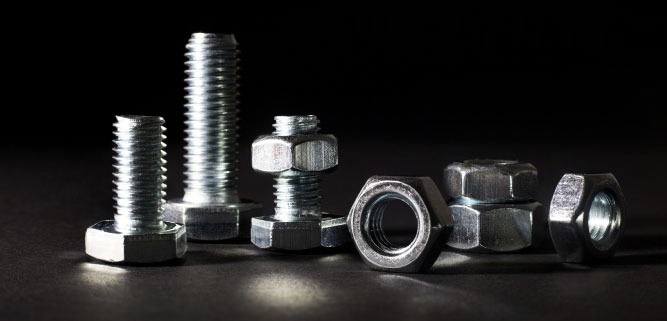
Hexagon head screws with fully threaded shanks are one of the most widely used fastening solutions in industrial and mechanical applications. Used for assembling structural components and machinery, they are distinguished by the combination of a hexagon head and full thread, which allows for effective and reliable tightening.
The reference standard is DIN 933, now harmonized internationally with the ISO 4017 standard, which defines their geometry, tolerances, and dimensional characteristics.
The main characteristics of this type of screw are:
Hexagonal head: allows the use of standard wrenches (open-end, polygonal, or socket wrenches), facilitating assembly and disassembly operations. This configuration allows high tightening torques to be applied, ensuring secure fastening and reducing the risk of loosening during operation.
Fully threaded shank: the thread extends from under the head to the end of the shank, ensuring uniform distribution of tension and a constant grip along the entire length of the screw. This feature makes DIN 933 screws particularly suitable for applications requiring stable and long-lasting tightening.
Available materials: DIN 933 screws are commonly manufactured in carbon steel (with different strength classes), alloy steel, stainless steel, and brass. The choice of material depends on the conditions of use, such as mechanical loads, exposure to corrosion, and the operating environment.
Standardized dimensions and tolerances: the standard precisely defines diameters, lengths, thread pitch, head height, and wrench sizes. This ensures full interchangeability between different manufacturers and simplifies the selection of the correct component during design or maintenance.
Thanks to their versatility and regulatory standardization, DIN 933 / ISO 4017 standards are still a fundamental reference in the industrial fastener and bolt industry.
DIN 933 standards are used in numerous fields, including:
Mechanical engineering: used for assembling and fastening machinery and components subject to high stress. Their mechanical strength guarantees stability and durability.
Construction and metalwork: used for assembling load-bearing structures and structural connections. They are suitable for supporting heavy loads and can be combined with other standardized elements, facilitating design and installation.
Automotive industry: used for fastening vehicle parts and components. High-strength steel or stainless steel versions ensure good resistance to vibrations, impacts, and external agents.
Electromechanical and electronic sector: used in the assembly of equipment and support structures, thanks to their full thread and availability in different materials, which expand their application compatibility.
This widespread use confirms their reliability as a standardized technical solution that is easily available on the market.
Hex nuts: DIN 934
The DIN 934 standard defines the standard for hex nuts used to create secure and resistant threaded joints. Designed to be used with metric screws and bolts, these nuts guarantee a reliable grip and uniform distribution of the tightening load, contributing to the stability of the assembly.
They are used in numerous industrial sectors, including:
Mechanical engineering: used in the assembly of machinery and components subject to vibration and mechanical stress, where a stable and durable connection is required.
Construction and metalwork: used in the assembly of frames, load-bearing structures, and scaffolding. Their ability to withstand high loads is essential in structural applications.
Automotive industry: used for fastening suspensions, engines, and transmission systems. Their resistance to vibrations and shocks makes them suitable for dynamic environments; any surface treatments increase their protection against corrosion.
Electromechanical and electronic sector: used in the assembly of devices and support structures, where the stability of the joint is essential to prevent malfunctions.
Hexagonal shape: allows the use of standard wrenches for assembly and disassembly and enables the application of high tightening torques, reducing the risk of loosening.
Materials: available in carbon steel, stainless steel, brass, and special alloys, depending on the environmental conditions and expected stresses.
Strength classes: generally 8, 10, and 12, which indicate the nut's ability to withstand certain loads in combination with the correct screw.
Surface treatments: zinc plating, burnishing, nickel plating, and other coatings improve corrosion resistance and durability.
Thanks to their standardization and reliability, DIN 934 nuts are still a fundamental solution in industrial and structural applications today.
Plain washers: DIN 125
DIN 125 flat washers are fasteners designed to distribute the clamping load evenly and protect contact surfaces. Used in combination with screws, bolts, and nuts, they are an essential component for ensuring stability, safety, and durability of the assembly, both in everyday applications and in industrial settings.
Main features:
Shape and dimensions: DIN 125 washers are circular with a concentric center hole, sized according to the diameter of the screw or bolt. The sizes are standardized to ensure interchangeability between different suppliers and to distribute the load correctly, reducing the risk of deformation or damage to the contact surfaces.
Materials: they are available in carbon steel, stainless steel, brass, and special alloys for specific applications. The choice depends on the environment of use and operating conditions, such as the presence of moisture, corrosive agents, or high temperatures.
Surface treatments: galvanizing, burnishing, phosphating, and other coatings improve corrosion resistance and increase durability, especially in aggressive environments or outdoors.
Main areas of application:
Mechanical engineering: used on machinery and equipment to distribute the clamping load and contribute to the stability of the joint, even in the presence of vibrations.
Construction and carpentry: used in the assembly of frames, structures, and metal supports, where they help prevent localized deformation and maintain the safety of joints over time.
Automotive industry: used in the fastening of engine, suspension, and body components. Their ability to maintain stable tightening under dynamic stresses is a determining factor.
Electromechanical and electronic sector: used in the assembly of devices and equipment, where they protect surfaces and ensure uniform tightening even on delicate components.
Thanks to their simple construction and regulatory standardization, DIN 125 washers are a fundamental element in any professional fastening system.
The importance of fasteners
Fasteners are essential components for ensuring safety, stability, and operational continuity in any assembly system. Whether in metal structures, machinery, or technical equipment, high-quality fasteners ensure that joints remain solid, reliable, and perform well over time, reducing the risk of failure, loosening, or breakdown.
The use of fasteners that comply with international standards is a determining factor in ensuring interchangeability, dimensional accuracy, and adequate mechanical performance. For this reason, the choice of certified and standardized elements is essential for all companies operating in the industrial, manufacturing, and infrastructure sectors, where reliability and safety cannot be compromised.
To receive further information about the world of fasteners, subscribe to our newsletter.
Metal sandblasting applied to small metal components: surface preparation, process control and its role in coatings for screws, bolts and threaded parts....
Technical guide to choosing anchors and bolts for air conditioner installation: substrate, bracket, anchoring, vibration, corrosion and proper tightening....
Drywall anchors: types, load capacity, selection criteria and correct installation to identify the most suitable fixing solution for every application....
Industrial automation is now a key factor in improving efficiency, quality, and control in manufacturing processes. By integrating machines, software, and data, companies can make their production more reliable, flexible, and competitive....
Threaded stud bolts are fasteners widely used in industry when it is necessary to ensure strong, reliable and above all time-demountable connections. Unlike traditional screws, they have a specific configuration that makes them particularly suitable ...
Carburizing is a thermochemical treatment that significantly improves steel performance by increasing surface hardness without compromising internal toughness. It is a fundamental solution for components subject to wear, friction and dynamic loads....
Surface treatments of steel are essential to ensure corrosion resistance, durability and reliable performance. Understanding which ones to choose and when to apply them helps you avoid problems, reduce costs, and improve component efficiency....
 Added to quote