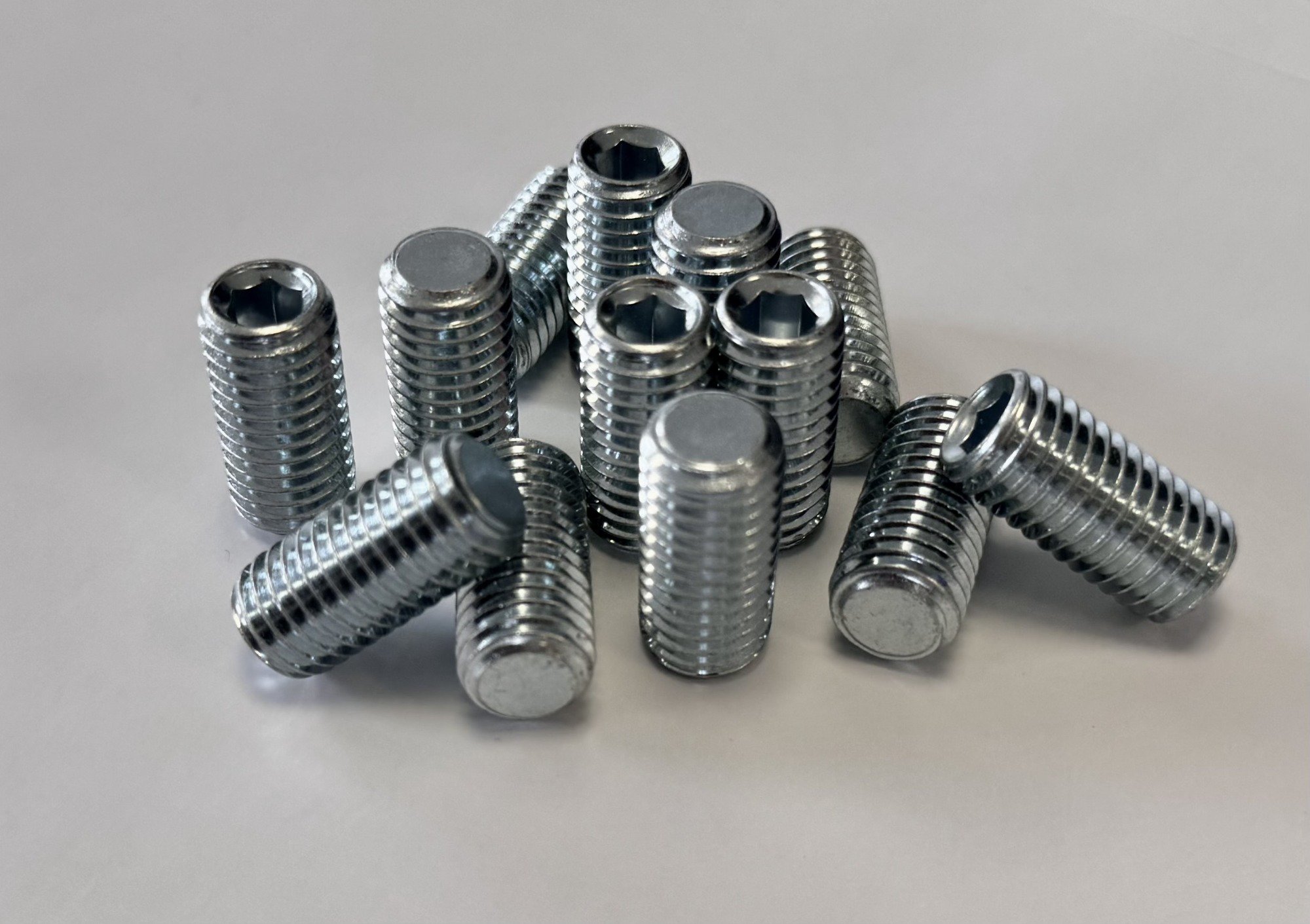
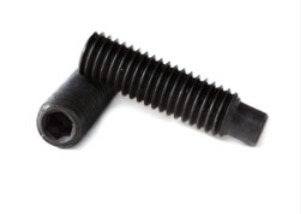
Hexagon socket set screws are a special type of headless screw, entirely threaded and equipped with an internal hexagon socket, which allows tightening with an Allen key. Unlike traditional screws, they do not connect two elements, but are used to lock one component against another.
They are screwed into threaded holes and tightened so as to exert pressure on the contact surface via the tip of the screw. This operating principle allows an object to be fixed inside or against another element by friction, preventing it from moving or rotating.
Hexagon socket set screws are commonly used to lock pulleys, gears, knobs, or other mechanical components onto a shaft, ensuring the stability of the system without the need for additional fasteners.
They are available in different sizes and with various types of tips to suit different application requirements and stress levels.
Hexagon socket set screws with cup point
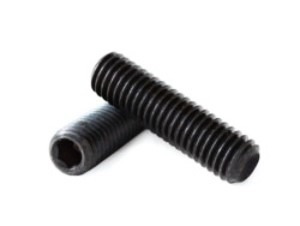
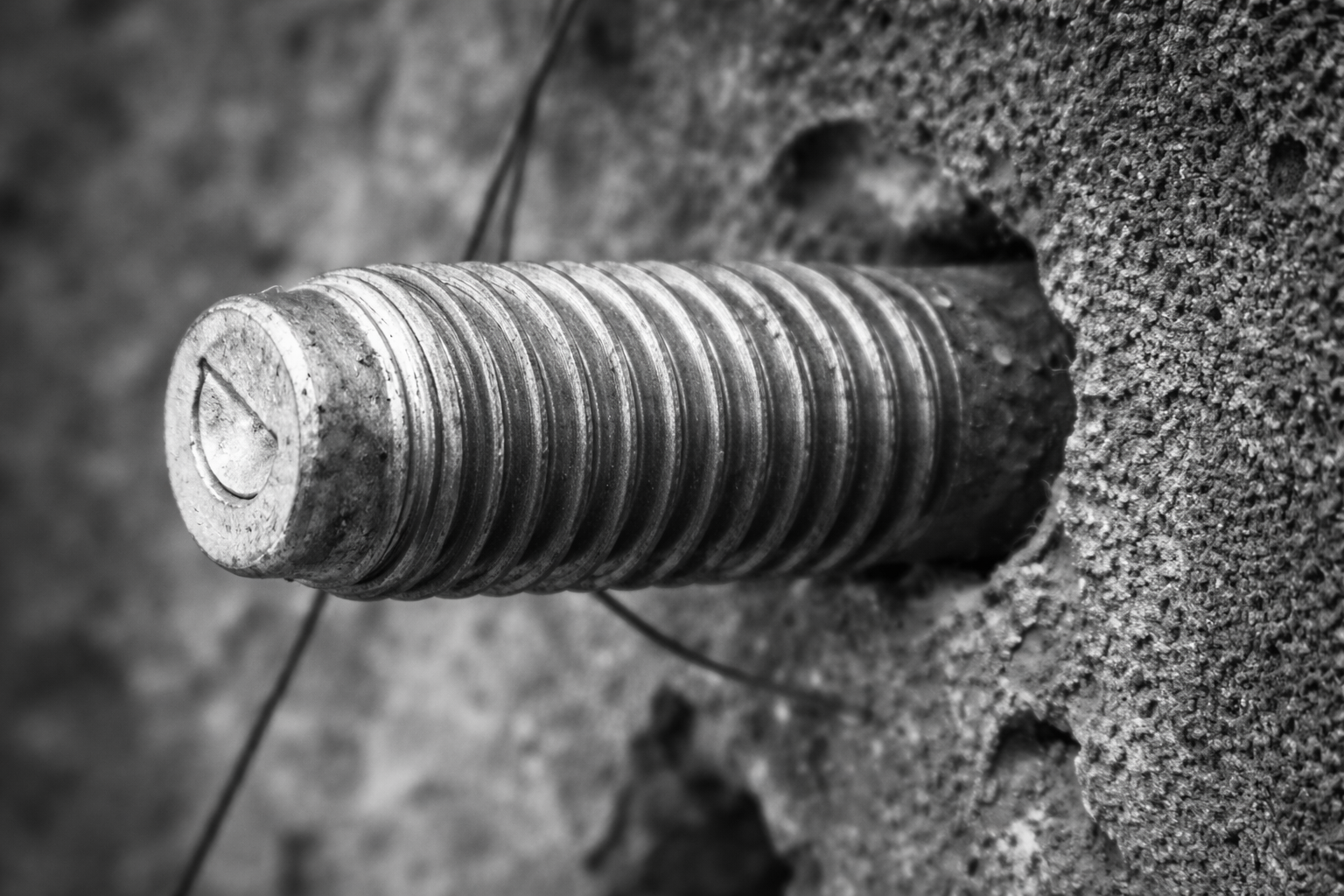
Hexagon socket set screws with cup points are the most common type of headless screws. They are designed to ensure effective locking on both soft and hard surfaces, thanks to the special shape of the tip. The recessed hexagon allows easy access in confined spaces, perfect for applications where smooth integration into the component is required.
The slightly concave cup tip tends to penetrate the contact surface during tightening, offering a high grip, good wear resistance, and greater stability over time. This feature makes them particularly suitable for applications subject to dynamic loads, vibrations, and repeated stresses, maintaining the correct positioning of the components.
Cup-point screws are commonly used for fastening pulleys, gears, bushings, and other mechanical elements on shafts, where it is necessary to prevent the component from slipping or rotating.
They are generally available in property class 45H, the most commonly used for this type of product, which guarantees a good balance between mechanical strength and toughness. In some specific applications, they can also be supplied in different materials or with different surface treatments, depending on the environment in which they are used.
The international reference standard for hexagon socket cap screws with cup points is ISO 4029 / DIN 916.
Hexagon socket set screws with flat point
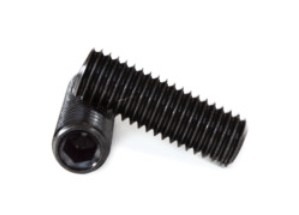
Hexagon socket screws with flat heads are designed for applications where uniform tightening force is required without damaging the contact surface. This makes them particularly suitable for tightening on soft metals, light alloys, or plastics.
The flat tip distributes pressure over a larger surface area than other tip types, reducing the risk of permanent deformation or marks on the tightened component. This feature makes them the ideal choice for applications that require frequent adjustments, disassembly, or repositioning, while maintaining the integrity of the surfaces.
From a mechanical point of view, these set screws are generally made in property class 45H, a standard class for headless set screws, which guarantees a good compromise between strength and ductility. Depending on the environment of use, they may be available with different surface treatments or specific materials.
The international reference standard for hexagon socket set screws with flat tips is ISO 4026 / DIN 913.
Hexagon socket set screws with cone point
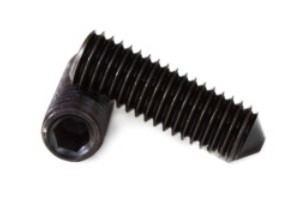
Hexagon socket screws with cone tips feature a sharp cone-shaped tip designed to penetrate the contact surface and ensure extremely effective locking. This geometry allows for greater axial force than other types of tips, ensuring a very stable grip.
Precisely because of this characteristic, conical tip grub screws are often used in permanent or semi-permanent connections, where frequent adjustments are not required. The penetration of the tip into the material creates a direct mechanical coupling, minimizing the risk of slippage or rotation of the fastened component.
They are widely used in the fastening of pulleys, gears, and mechanical components subject to high stresses, but can also be used as positioning pins or locking elements, depending on the project.
From a mechanical point of view, these grub screws are generally manufactured in property class 45H, which is suitable for ensuring high resistance to wear and stress concentrated at the tip. Depending on the application, they can be supplied with specific surface treatments or in alternative materials.
The international reference standard for hexagon socket grub screws with conical tips is ISO 4027 / DIN 914.
Hexagon socket set screws with full dog point
Hexagonal socket set screws with full dog point feature a protruding cylindrical tip (tang) that fits into the corresponding hole in the component to be fastened, effectively acting as a positioning pin.
Unlike other types of studs that work mainly by friction, studs with shanks ensure direct mechanical coupling, effectively limiting radial displacement and rotation of the component. This feature makes them particularly suitable for applications that require precise and repeatable positioning.
They are commonly used to secure pulleys, gears, bushings, and mechanical components on shafts, especially when it is necessary to ensure correct alignment between parts. The tang also reduces wear on contact surfaces compared to solutions based exclusively on pressure.
From a mechanical point of view, hexagon socket set screws with shanks are generally made in property class 45H, which is suitable for withstanding the loads and stresses typical of mechanical applications. Depending on the environment of use, they may also be available with specific surface treatments.
The international reference standard for this type of set screw is ISO 4028 / DIN 915.
Stability, safety, and precision in mechanical fastening
Hexagon socket screws are a reliable and versatile fastening solution for numerous mechanical and industrial applications. The absence of a head, combined with the availability of different tip types, materials, and strength classes, allows this component to be adapted to a wide range of requirements, from simple positioning to the most demanding fastening applications. Understanding the characteristics of the various versions available allows you to make an informed choice, improving assembly stability, operational safety, and the durability of connections.
To receive further information about the world of fasteners, subscribe to our newsletter.
Metal sandblasting applied to small metal components: surface preparation, process control and its role in coatings for screws, bolts and threaded parts....
Technical guide to choosing anchors and bolts for air conditioner installation: substrate, bracket, anchoring, vibration, corrosion and proper tightening....
Drywall anchors: types, load capacity, selection criteria and correct installation to identify the most suitable fixing solution for every application....
Industrial automation is now a key factor in improving efficiency, quality, and control in manufacturing processes. By integrating machines, software, and data, companies can make their production more reliable, flexible, and competitive....
Threaded stud bolts are fasteners widely used in industry when it is necessary to ensure strong, reliable and above all time-demountable connections. Unlike traditional screws, they have a specific configuration that makes them particularly suitable ...
Carburizing is a thermochemical treatment that significantly improves steel performance by increasing surface hardness without compromising internal toughness. It is a fundamental solution for components subject to wear, friction and dynamic loads....
Surface treatments of steel are essential to ensure corrosion resistance, durability and reliable performance. Understanding which ones to choose and when to apply them helps you avoid problems, reduce costs, and improve component efficiency....
In the metal fabrication and construction industries, structural connection and reinforcement systems play a fundamental role in ensuring long-term stability and safety. Among these, steel tension rods are a widely used technical solution for absorbi...
The metalworking sector is one of the pillars of modern industry. But what does it actually encompass? What are its categories, and what jobs fall under it? In this article, we provide a clear and comprehensive analysis of one of the most strategic s...
Behind every product that reaches the market lies a complex network of suppliers, production processes, logistics, and distribution. Supply Chain Management was developed precisely to efficiently coordinate all these activities, transforming supply c...
 Added to quote