Drywall Anchors: Types, Load Capacity and Selection Criteria
Drywall anchors require specific selection criteria, as the substrate has very different mechanical characteristics compared with concrete or solid masonry.
The board has a limited thickness and, in most applications, is separated from the supporting structure behind it by a cavity that affects the behaviour of the fixing.
To choose drywall anchors that are truly suitable for the application and the expected stresses, it is therefore necessary to correctly assess the thickness and number of boards, the available depth within the cavity, the magnitude and direction of the load, and the installation method.
Let us take a closer look below.
Types of Drywall Anchors and How They Work
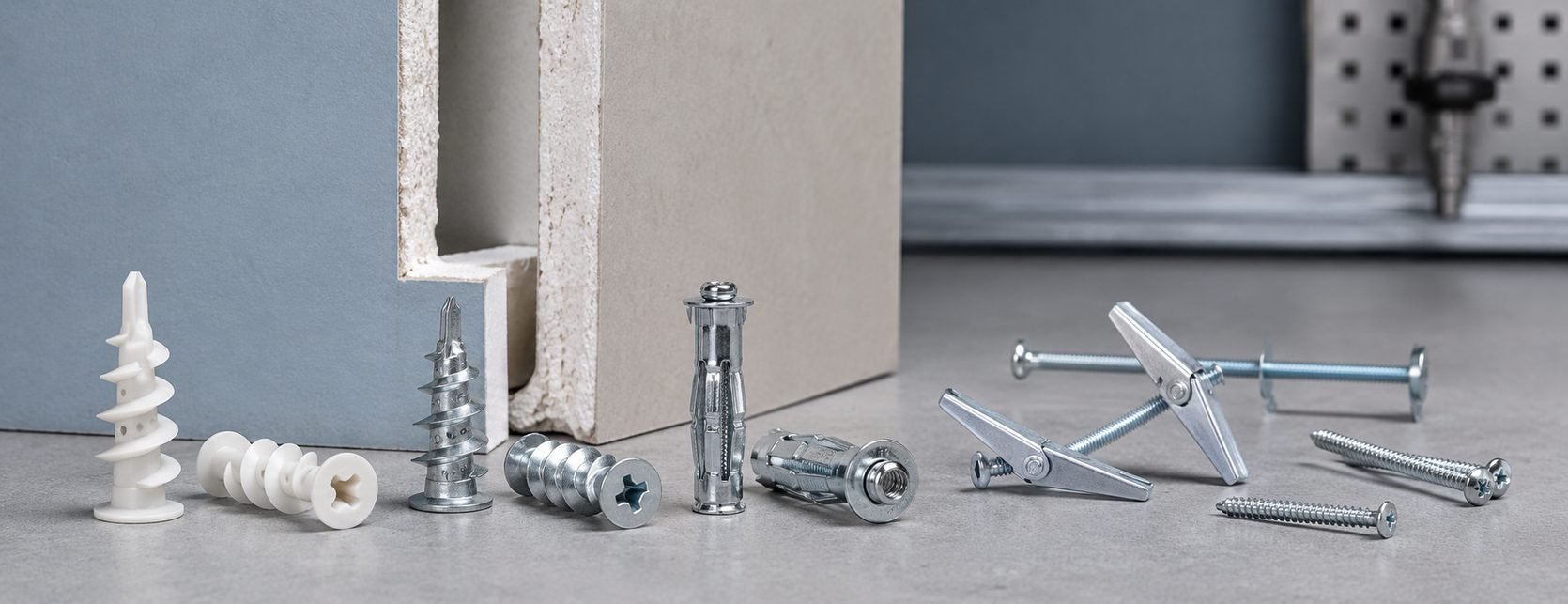
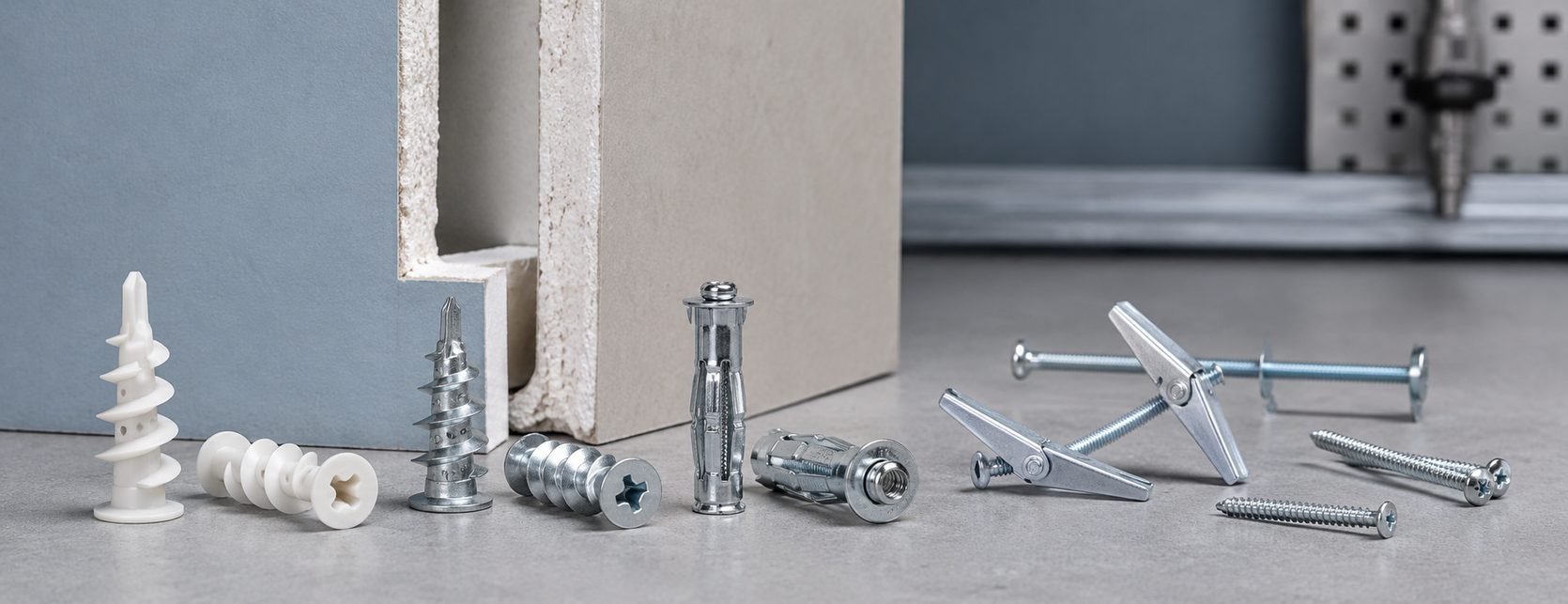
Among the best solutions for drywall are self-drilling anchors, made of plastic or metal and designed to be screwed directly into the board to create an anchoring point in the panel. Thanks to the limited space they require behind the board, they are particularly suitable for light-duty fixings.
Some models can be installed without pre-drilling on a single board, while with double-layer boards or gypsum fibreboards it is necessary to follow the manufacturer’s specific instructions.
For heavier-duty applications, systems capable of creating mechanical resistance on the rear side of the board are used. Metal expansion anchors, often identified as “Molly” anchors, deform behind the panel, creating a clamping action between the front section and the rear wings.
The choice must take into account a grip range compatible with the wall thickness and, in many cases, installation is carried out using a dedicated setting tool.
There are also toggle anchors, which pass through the board and open inside the cavity, increasing the rear bearing surface. They therefore require sufficient free depth to allow the system to open correctly.
Universal nylon anchors can also be used on hollow substrates, but only when this application is expressly specified by the manufacturer. For further information, you can consult our range of fastening systems.
The load capacity of drywall anchors cannot be reduced to a single value: it must be assessed on the basis of the technical data relating to the specific combination of fixing system and substrate.
Performance can in fact vary significantly depending on the thickness of the board, the number of overlapping panels and the type of material, such as standard drywall or gypsum fibreboard.
It is also essential to distinguish between the different types of load, which must be interpreted according to the information provided in the product’s technical documentation. In particular:
·Breaking load: the maximum load recorded during a test before failure of the fixing or substrate;
·Allowable load: the value that can be used in service after applying the safety factors specified by the manufacturer or by the assessment method;
·Recommended load: the load that the manufacturer recommends not exceeding under the specified installation conditions.
The breaking load is always the least useful value when choosing an anchor directly, as it represents the limit value rather than normal use. It is more useful to refer to the recommended or allowable load specified by the manufacturer for the particular substrate.
The direction of the stress also has a significant effect on the behaviour of the fixing. An element installed flush against the wall mainly subjects the anchor to shear, while a deep shelf, wall cabinet or articulated bracket can generate a moment that increases the tensile force on the upper fixings.
Using several anchors does not automatically result in an overall load capacity equal to the sum of the individual values: the distance between fixing points, the rigidity of the installed element and the actual distribution of loads must also be considered.
Ceiling installations, finally, must be assessed separately, using only fixings expressly suitable for that configuration.
How to Choose and Set Up the Installation
The choice of anchor must begin with a correct assessment of the substrate, considering the type of board, its thickness, the presence of one or more layers and the available depth within the cavity.
It is also essential to check the position of any metal or timber studs. In the case of high loads, highly projecting elements or repeated stresses, it may be preferable to anchor the fixing directly to the supporting structure or to a suitable reinforcement, rather than placing the entire load on the drywall board alone.
The dimensions of the anchor must also be compatible with the system. The length and grip range must be appropriate for the actual thickness of the panel, while toggle or anchor fixings require sufficient space behind the board to allow them to open correctly.
The hole must comply with the diameter specified by the manufacturer and tightening must be controlled to avoid local damage to the board.
It is also necessary to distinguish between anchors intended for securing loads and screws used to install the panels. Self-tapping screws for drywall and self-drilling screws for drywall, for example, are used to fix the boards to the supporting structure and do not replace a specific anchor when an object has to be attached to the finished wall.
The correct choice of drywall anchors therefore essentially depends on the compatibility between the characteristics of the substrate, the type of anchor, the screw used, the magnitude and direction of the load, and the installation conditions. Only by assessing these elements together, in light of the product’s technical data, is it possible to identify a solution that is truly suitable for the application.
Metal sandblasting applied to small metal components: surface preparation, process control and its role in coatings for screws, bolts and threaded parts....
Technical guide to choosing anchors and bolts for air conditioner installation: substrate, bracket, anchoring, vibration, corrosion and proper tightening....
Drywall anchors: types, load capacity, selection criteria and correct installation to identify the most suitable fixing solution for every application....
Industrial automation is now a key factor in improving efficiency, quality, and control in manufacturing processes. By integrating machines, software, and data, companies can make their production more reliable, flexible, and competitive....
Threaded stud bolts are fasteners widely used in industry when it is necessary to ensure strong, reliable and above all time-demountable connections. Unlike traditional screws, they have a specific configuration that makes them particularly suitable ...
Carburizing is a thermochemical treatment that significantly improves steel performance by increasing surface hardness without compromising internal toughness. It is a fundamental solution for components subject to wear, friction and dynamic loads....
Surface treatments of steel are essential to ensure corrosion resistance, durability and reliable performance. Understanding which ones to choose and when to apply them helps you avoid problems, reduce costs, and improve component efficiency....
 Added to quote