How to remove a stripped screw without damaging the component
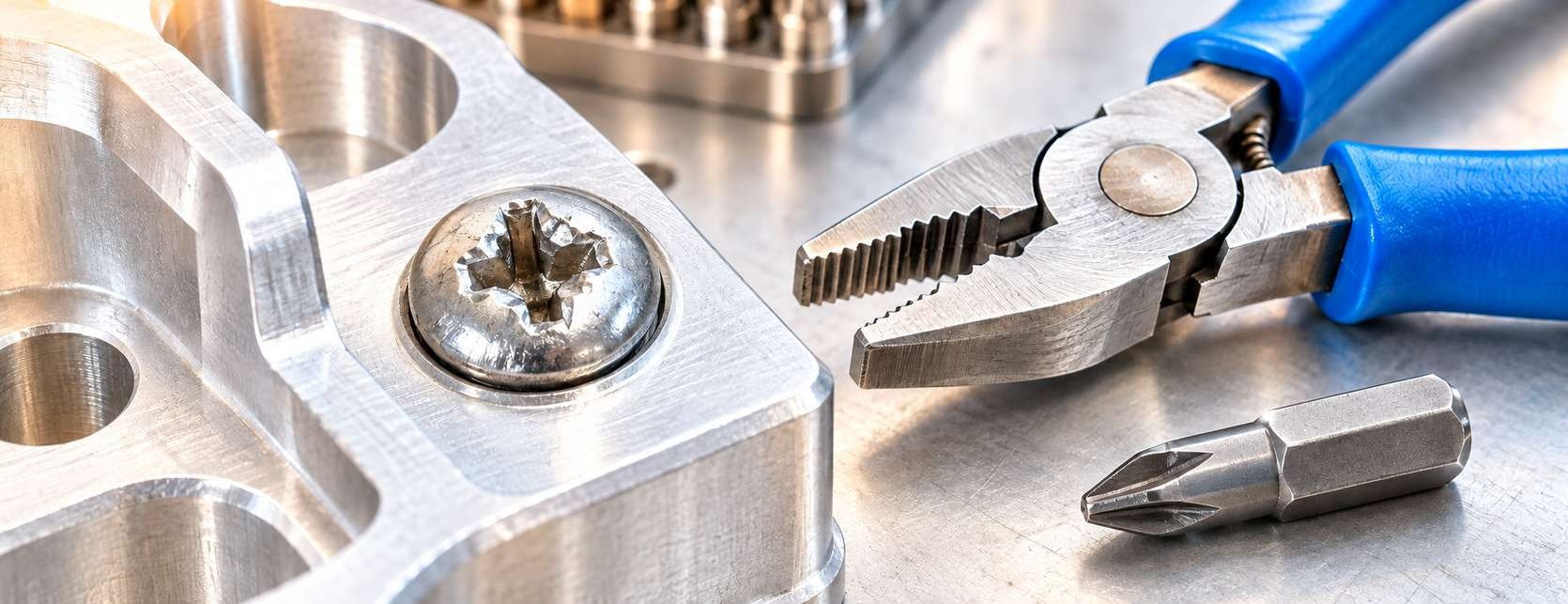
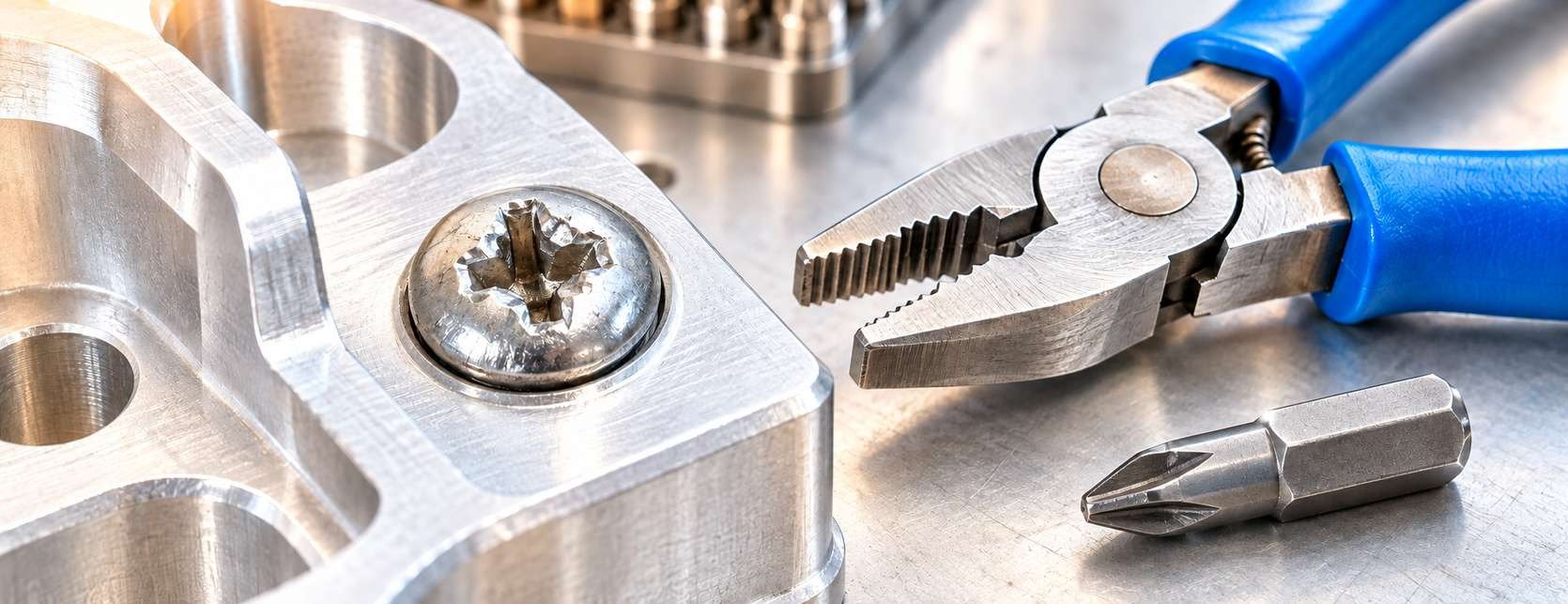
To understand how to remove a stripped screw, first assess whether the damaged recess still allows the tool to transmit the torque needed to loosen it. Continuing when the bit slips removes more material from the head, further reducing the chances of extraction.
Head accessibility and the condition of the threaded connection determine how to proceed: removing a stripped screw with pliers or an extractor requires different conditions and precautions.
The aim is to preserve the threaded hole and surrounding surfaces, even when the screw itself must be sacrificed.
Stripped screw: damaged drive recess or damaged threads?
The term “stripped screw” can refer either to a damaged drive recess or to damaged threads. Distinguishing between these conditions makes it possible to choose the most appropriate method.
When the screwdriver turns inside the recess without turning the screw, the contact surfaces in the head no longer provide an effective grip. If the screw turns but does not back out, check the integrity of the threads and whether the nut or insert into which it is threaded is also rotating.
If the screw resists turning, consider whether the threaded connection is seized or locked by corrosion, galling or threadlocking adhesives.
Where corrosion is present, a dedicated penetrating fluid may help free the screw, provided it reaches the threads. Follow the manufacturer’s instructions on application time and compatibility; any reduction in loosening resistance will not, however, restore grip in the damaged recess.
Cleaning the drive recess makes it possible to identify its profile, assess its condition and check how well the tool fits. Phillips (PH) and Pozidriv (PZ) cross recesses require matching bits, as do hex socket and six-lobe recesses. A bit that enters the head but has excessive play may slip under torque and worsen the damage.
To identify the fastener, distinguish between head geometry, drive recess type and dimensions. Learn more in our guide to screw and bolt sizes.
Restoring grip without worsening the damage
Recess condition and head accessibility determine how to remove a stripped screw while preserving the component.
If the recess retains sufficient surfaces to transmit rotation, an attempt can be made with an undamaged tool of the correct size, kept aligned with the screw’s axis. Pressure along this axis helps keep the bit engaged, while slow, controlled rotation allows the grip to be assessed.
If the bit slips, stop the attempt: continuing further wears the recess and may scratch the surrounding surfaces.
When internal engagement is no longer sufficient, a protruding head may allow the use of dedicated screw extraction pliers. The serrated jaws grip the outside of the head, allowing torque to be applied without using the damaged recess.
For this method to work, there must be enough space to position the pliers and enough exposed head to grip. During rotation, the tool must act on the screw alone, without levering against the component. A countersunk head flush with the surface generally offers no accessible edge for the jaws.
Head geometry therefore guides tool selection, but a stable grip does not eliminate the causes of a seized or locked threaded connection. If the screw remains stationary, applying more force may further deform the head or break the shank. Before proceeding, reassess the resistance encountered and choose an extraction method suited to the condition of the fastener.
How to remove a stripped screw with an extractor
When the recess can no longer transmit torque and the head cannot be gripped from the outside, a compatible extractor can be considered, taking into account the screw’s dimensions and material.
With conventional spiral extractors, the operation begins by drilling a centred hole in the screw, using the drill bit diameter specified by the manufacturer. The extractor is inserted into this pilot hole and turned anticlockwise: by gripping the walls, it transmits the rotation needed to remove a fastener with a right-hand thread.
The drill bit and extractor must be matched according to the instructions for the system used, taking into account the screw’s dimensions and material.
At this stage, machining accuracy is essential to protect the threaded hole. Drilling must remain aligned with the screw’s axis and reach the depth required for engagement, without cutting into the female threads or components behind them. The component must also be protected from swarf, and the tools checked for compatibility with the fastener’s hardness.
Deciding how to remove the stripped screw therefore also requires an understanding of the chosen system’s limitations: some extractors are unsuitable for very hard screws and may be ineffective on threaded connections completely locked by corrosion or adhesives.
If the screw does not move, stop the operation to avoid overloading the extractor and making recovery more difficult.
After removal, inspecting the internal threads and bearing surfaces allows the condition of the joint to be assessed before reassembly.
The damaged screw must be replaced with a replacement that meets the specified requirements: diameter, pitch, length, head geometry, material and mechanical strength. Our catalogue of metric-thread screws and boltsprovides details of the available configurations.
If the threaded hole is damaged, assess how it can be repaired: replacing the screw alone does not restore the necessary holding capacity of damaged threads.
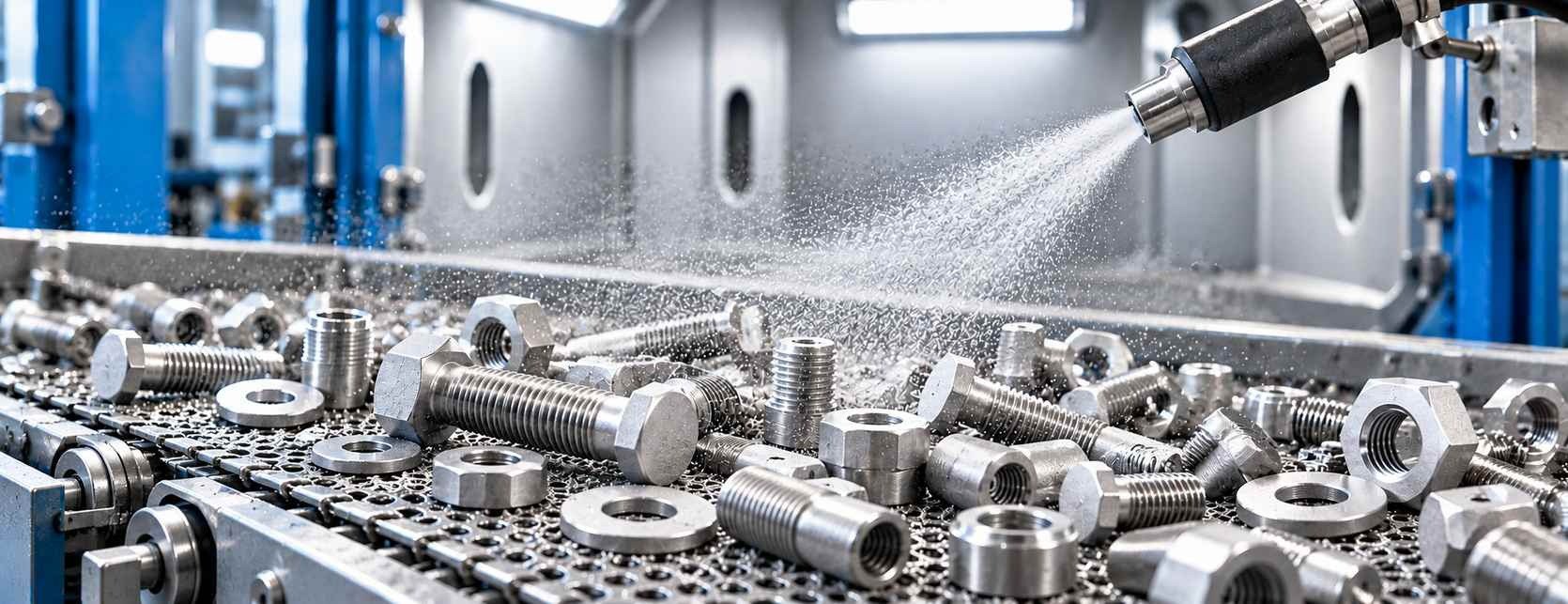
Metal sandblasting applied to small metal components: surface preparation, process control and its role in coatings for screws, bolts and threaded parts....
Technical guide to choosing anchors and bolts for air conditioner installation: substrate, bracket, anchoring, vibration, corrosion and proper tightening....
Drywall anchors: types, load capacity, selection criteria and correct installation to identify the most suitable fixing solution for every application....
Industrial automation is now a key factor in improving efficiency, quality, and control in manufacturing processes. By integrating machines, software, and data, companies can make their production more reliable, flexible, and competitive....
Threaded stud bolts are fasteners widely used in industry when it is necessary to ensure strong, reliable and above all time-demountable connections. Unlike traditional screws, they have a specific configuration that makes them particularly suitable ...
Carburizing is a thermochemical treatment that significantly improves steel performance by increasing surface hardness without compromising internal toughness. It is a fundamental solution for components subject to wear, friction and dynamic loads....
Surface treatments of steel are essential to ensure corrosion resistance, durability and reliable performance. Understanding which ones to choose and when to apply them helps you avoid problems, reduce costs, and improve component efficiency....
In the metal fabrication and construction industries, structural connection and reinforcement systems play a fundamental role in ensuring long-term stability and safety. Among these, steel tension rods are a widely used technical solution for absorbi...
 Added to quote