Steel Tension Rods: Types, Sizing, and Structural Applications
Steel tie rods are elements designed to work exclusively under tension. Their primary function is to counteract forces that would tend to deform, separate, or destabilize a structure.
The operating principle is relatively simple: the tie rod is installed between two points of the structure and, once tensioned, helps maintain the balance of the connected elements, preventing displacement or sagging.
This type of solution is particularly common when:
it is necessary to stiffen an existing structure
horizontal forces must be counteracted (such as in arches or roofs)
the stability of frames and bracing needs to be improved
work is being carried out on existing buildings for the purpose of reinforcement
In industrial and civil engineering, tie rods are used in industrial buildings, bridges, roofs, truss structures, and reinforcement projects on masonry or concrete buildings.
Types of tie rods for construction
In the construction sector, steel tie rods can take on various configurations, depending on their structural function and installation method.
One of the most common solutions is threaded tie rods, made from threaded bars (similar to DIN 975 bars), which allow for precise tension adjustment via nuts and clamping systems. This configuration is particularly valued for its versatility and ease of installation.
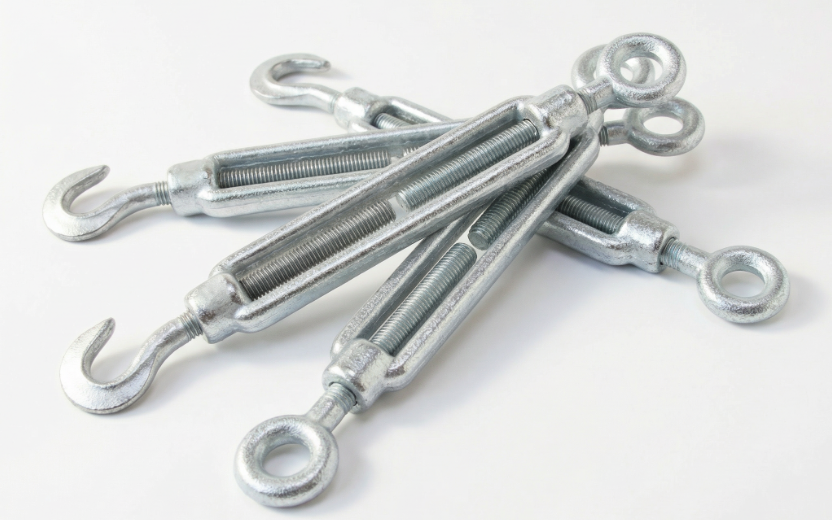
In addition to these, there are tie rods with tensioners, which are used when it is necessary to adjust the tension even after installation. The tensioner allows the tensile force to be increased or decreased without dismantling the system, making it ideal for structures subject to settlement or changes over time.
Another category consists of structural tie rods with forged ends or specific anchoring systems, designed for high-strength applications. In these cases, the tie rod is not a simple threaded element, but an engineered component designed to operate under critical conditions, often combined with plates, joints, or articulation systems.
Finally, in more complex contexts, complete tensioning systems are used, consisting of bars, nuts, and certified accessories, designed as a single structural system.
How are tie rods sized?
The sizing of steel tie rods is a critical step in the design phase, as the safety of the entire structure depends on it.
Unlike common fasteners, a tie rod must be designed by considering the actual stresses it will be subjected to during operation. The primary parameter is the tensile force, which results from the loads applied to the structure (self-weight, wind, snow, accidental loads).
The sizing process generally involves:
determining the applied tensile force
selecting the material (e.g., S235 steel, S355 steel, or high-strength steels)
verification of the tie rod’s cross-sectional strength
checking of allowable stresses against code requirements
A crucial aspect concerns the selection of the bar diameter. An insufficient diameter can lead to excessive deformation or, in the most critical cases, to tie rod failure. Conversely, oversizing results in unnecessary costs and installation difficulties.
It is also important to consider secondary but critical factors, such as:
the free length of the tie rod (affects deformability)
the type of thread and the strength of the nuts
environmental conditions (corrosion, temperature)
In many cases, sizing is performed using specific structural calculations or engineering software, especially for complex or high-risk applications.
Steel Tie Rod Standards
As with standardized fasteners and bolts, steel tie rods must also comply with specific technical standards that ensure their performance, safety, and reliability.
In the European context, the primary reference is the Eurocodes, specifically:
Eurocode 3 (EN 1993) for the design of steel structures
EN 1090 for the execution of steel structures
material standards (such as EN 10025 for structural steels)
Unlike DIN or ISO tie rods, are not always identified by a single, unambiguous dimensional standard, but are part of a broader structural design system. This means that each tie rods must be verified within the specific context in which it is used.
Material and component certifications also play a fundamental role, as they must ensure:
product traceability
declared mechanical properties
compliance with design requirements
In the case of work on existing buildings or infrastructure projects, national regulations and specific guidelines for structural reinforcement may also apply.
The Role of Tension Rods in Modern Structures
Steel tension rods are a key element in contemporary structural design. Their ability to withstand tensile forces makes them indispensable for ensuring stability, safety, and durability in numerous applications.
Just as with standardized fasteners, material quality, proper design, and compliance with regulations are critical factors for tie rods. An incorrect choice or approximate sizing can compromise the entire structural system.
For this reason, the correct approach is not to view the tie rod as a simple component, but as an integral part of a broader engineering system, in which every element contributes to the structure’s overall performance.
To receive further information about the world of fasteners, subscribe to our newsletter.
Technical guide to choosing anchors and bolts for air conditioner installation: substrate, bracket, anchoring, vibration, corrosion and proper tightening....
Drywall anchors: types, load capacity, selection criteria and correct installation to identify the most suitable fixing solution for every application....
Industrial automation is now a key factor in improving efficiency, quality, and control in manufacturing processes. By integrating machines, software, and data, companies can make their production more reliable, flexible, and competitive....
Threaded stud bolts are fasteners widely used in industry when it is necessary to ensure strong, reliable and above all time-demountable connections. Unlike traditional screws, they have a specific configuration that makes them particularly suitable ...
Carburizing is a thermochemical treatment that significantly improves steel performance by increasing surface hardness without compromising internal toughness. It is a fundamental solution for components subject to wear, friction and dynamic loads....
Surface treatments of steel are essential to ensure corrosion resistance, durability and reliable performance. Understanding which ones to choose and when to apply them helps you avoid problems, reduce costs, and improve component efficiency....
In the metal fabrication and construction industries, structural connection and reinforcement systems play a fundamental role in ensuring long-term stability and safety. Among these, steel tension rods are a widely used technical solution for absorbi...
The metalworking sector is one of the pillars of modern industry. But what does it actually encompass? What are its categories, and what jobs fall under it? In this article, we provide a clear and comprehensive analysis of one of the most strategic s...
Behind every product that reaches the market lies a complex network of suppliers, production processes, logistics, and distribution. Supply Chain Management was developed precisely to efficiently coordinate all these activities, transforming supply c...
Heat treatment of steel is one of the most important processes for obtaining reliable, resistant metal components suitable for industrial applications. From normalizing to tempering, these processes modify the structure of the material and determine ...
 Added to quote