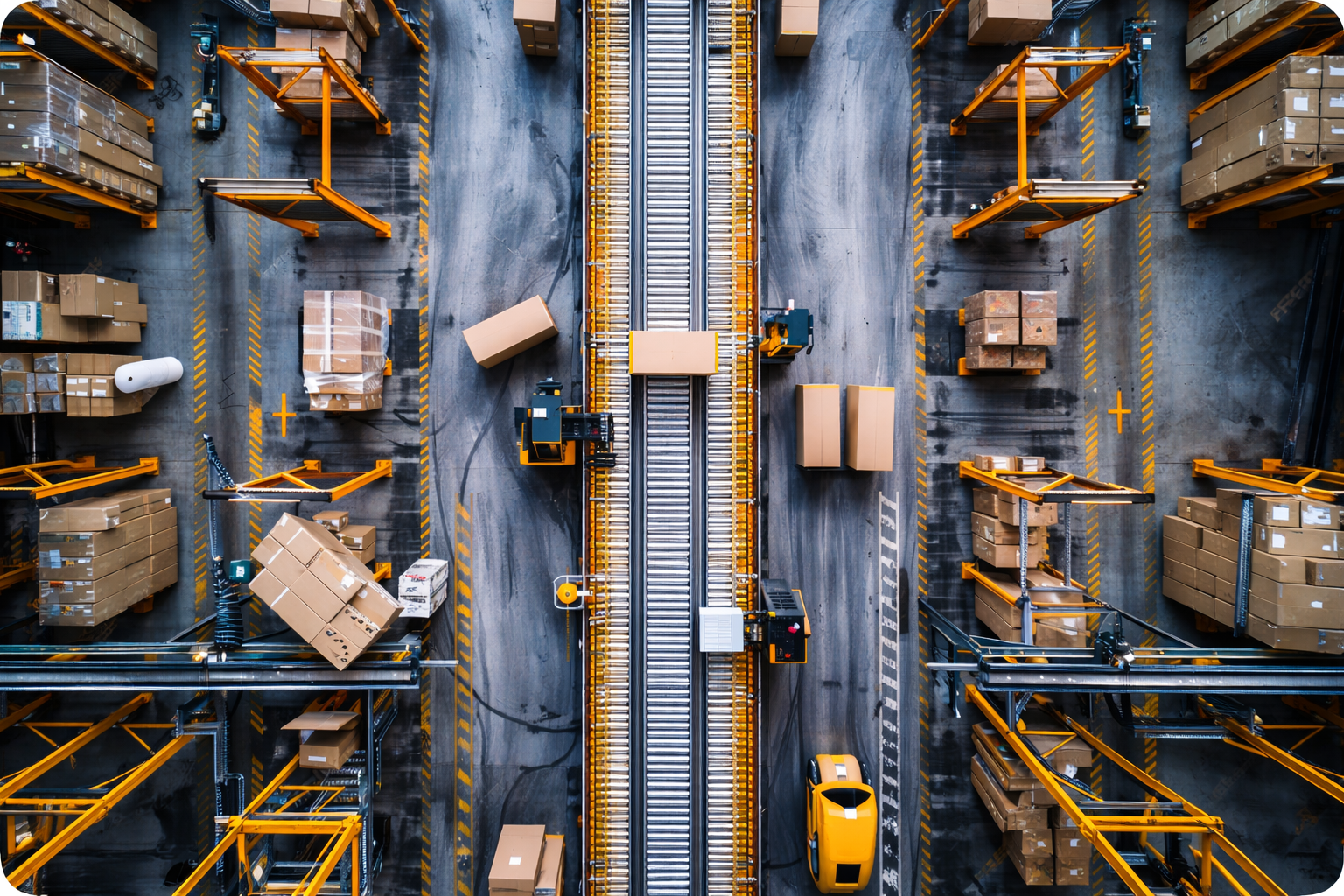
Supply Chain Management: What It Is, How It Works, and Why It Has Become Strategic for Businesses
Supply Chain Management (SCM) is the set of activities and strategies used to manage and coordinate the entire supply chain, from the procurement of raw materials to the delivery of the finished product to the end customer. It is therefore not a single business process, but an integrated system involving various stakeholders, including suppliers, manufacturers, distributors, logistics operators, and customers.
The main objective of Supply Chain Management is to optimize the flow of materials, information, and financial resources throughout the entire production chain. This means coordinating activities such as procurement, production, inventory management, and distribution in order to reduce inefficiencies and improve the organization’s overall performance.
Over time, the concept of the supply chain has evolved significantly. In the past, companies tended to focus primarily on internal processes, such as production or warehousing. Today, however, it is increasingly clear that a company’s success also depends on its ability to collaborate and coordinate with all other entities that are part of the value chain. In this context, Supply Chain Management represents a strategic approach that enables the management of the supply chain in a systematic and integrated manner.
How the Supply Chain Works
To understand how supply chain management works, it is helpful to examine the key activities that make up the supply chain. The supply chain is not, in fact, a linear process, but rather a set of interconnected operations that must be precisely coordinated.
Key stages of the supply chain include demand forecasting, supplier management, raw material procurement, production, inventory management, order processing, and product distribution. These activities are complemented by processes such as returns management and so-called reverse logistics, which involves the return flow of products within the supply chain.
Every stage of the chain is closely linked to the others. A delay in the delivery of raw materials, for example, can slow down production; similarly, an inaccurate demand forecast can lead to excess inventory or, conversely, product shortages. For this reason, Supply Chain Management aims to coordinate all these activities through careful planning and a constant exchange of information among the various stakeholders involved.
Why Supply Chain Management Is So Important
In recent years, supply chain management has become one of the most critical factors in a company’s competitiveness. In increasingly dynamic and globalized markets, the ability to efficiently manage the supply chain can make the difference between an organization that is able to grow and one that struggles to maintain its position.
One of the main advantages of a well-organized supply chain is the reduction of operating costs. By optimizing production processes, inventory management, and logistics activities, companies can reduce waste, improve resource utilization, and lower costs associated with the transportation and storage of goods. All of this also helps improve profit margins.
Another key aspect concerns the ability torespond quickly to market demands. In an environment where demand can change rapidly, having a flexible supply chain allows companies to adapt production, better manage procurement, and ensure product availability when and where they are needed.
Finally, efficient supply chain management also has a direct impact on custumer's satisfaction. On-time deliveries, consistent product availability, and greater service reliability help strengthen the relationship of trust between the company and its customers, thereby improving customer loyalty and the brand’s reputation.
The Challenges of the Modern Supply Chain
Contemporary supply chains have become far more complex than in the past. The globalization of markets has led many companies to collaborate with suppliers and partners located in different countries, creating long and intricate supply networks.
This complexity also brings new vulnerabilities. Unforeseen events such as geopolitical crises, transportation disruptions, natural disasters, or sudden spikes in demand can put pressure on the entire production chain. In recent years, numerous industrial sectors have faced challenges related to raw material availability, delivery times, and the management of international transportation.
To address these challenges, companies are increasingly focusing on supply chain resilience—that is, the ability to prevent risks and respond quickly to unforeseen events. This means diversifying suppliers, improving visibility into logistics flows, and developing more advanced planning systems.
The Role of Data in Supply Chain Management
One of the factors most significantly transforming supply chain management is the use of data. Today, companies have access to an ever-increasing amount of information from sales, orders, production, and logistics. If this data is collected and analyzed properly, it can become an extremely powerful tool for improving supply chain management.
For example, historical sales data enables more accurate demand forecasting, allowing companies to better plan production and reduce both stockouts and excess inventory. Similarly, sharing information across different departments—such as sales, production, and logistics—helps coordinate activities and make faster, more informed decisions.
In many cases, customer relationship management (CRM) systems are integrated with management platforms and production systems to gain a more comprehensive view of how the company operates. This data integration enables companies to anticipate market needs and improve the overall efficiency of the supply chain.
The Technologies Transforming the Supply Chain
Digitalization is playing an increasingly important role in supply chain management. Various technologies are helping to make supply chains more efficient, transparent, and flexible.
Among these, the Internet of Things (IoT) enables real-time monitoring of the location and condition of goods throughout the logistics process. Sensors, RFID tags, and other devices make it possible to track products and collect data useful for improving warehouse and shipping management.
Artificial Intelligence, on the other hand, is used to analyze large amounts of data and identify patterns useful for demand forecasting, optimizing transport routes, and production planning.
Cloud computing and digital platforms are also helping to improve collaboration among the various players in the supply chain, making it easier to share information and integrate business systems.
Thanks to these technologies, companies can gain ever-greater visibility across the entire supply chain and respond more quickly to problems or inefficiencies.
The Role of the Supply Chain Manager
Managing an efficient supply chain requires specific skills and a strategic vision of the entire organization. For this reason, many companies entrust the oversight of the supply chain to a dedicated professional: the Supply Chain Manager.
This role is responsible for planning, coordinating, and monitoring all activities that make up the supply chain. The Supply Chain Manager must ensure that production, logistics, and sales processes are aligned and that the supply chain operates smoothly and efficiently.
In addition to technical skills, this professional must also possess organizational, analytical, and leadership skills, as they often need to coordinate different teams and collaborate with suppliers, logistics partners, and other company departments.
The Future of the Supply Chain
Looking ahead, it is clear that supply chain management will continue to evolve rapidly. Companies are increasingly investing in the digitization of processes, the automation of logistics operations, and the use of data to support strategic decision-making.
At the same time, there is growing attention to issues such as sustainability and environmental responsibility, especially in the European Union. More and more organizations are seeking to reduce the environmental impact of their supply chains by adopting solutions such as low-emission transportation, sustainable packaging, and circular economy models.
In an economic climate marked by great uncertainty and rapid change, efficient supply chain management is therefore one of the key levers companies can rely on to improve their competitiveness and build long-term growth.
To receive more information about the world of fasteners, subscribe to our newsletter.
Drywall anchors: types, load capacity, selection criteria and correct installation to identify the most suitable fixing solution for every application....
Industrial automation is now a key factor in improving efficiency, quality, and control in manufacturing processes. By integrating machines, software, and data, companies can make their production more reliable, flexible, and competitive....
Threaded stud bolts are fasteners widely used in industry when it is necessary to ensure strong, reliable and above all time-demountable connections. Unlike traditional screws, they have a specific configuration that makes them particularly suitable ...
Carburizing is a thermochemical treatment that significantly improves steel performance by increasing surface hardness without compromising internal toughness. It is a fundamental solution for components subject to wear, friction and dynamic loads....
Surface treatments of steel are essential to ensure corrosion resistance, durability and reliable performance. Understanding which ones to choose and when to apply them helps you avoid problems, reduce costs, and improve component efficiency....
In the metal fabrication and construction industries, structural connection and reinforcement systems play a fundamental role in ensuring long-term stability and safety. Among these, steel tension rods are a widely used technical solution for absorbi...
The metalworking sector is one of the pillars of modern industry. But what does it actually encompass? What are its categories, and what jobs fall under it? In this article, we provide a clear and comprehensive analysis of one of the most strategic s...
Behind every product that reaches the market lies a complex network of suppliers, production processes, logistics, and distribution. Supply Chain Management was developed precisely to efficiently coordinate all these activities, transforming supply c...
Heat treatment of steel is one of the most important processes for obtaining reliable, resistant metal components suitable for industrial applications. From normalizing to tempering, these processes modify the structure of the material and determine ...
 Added to quote