Universal joint: screws, pins and fastening systems
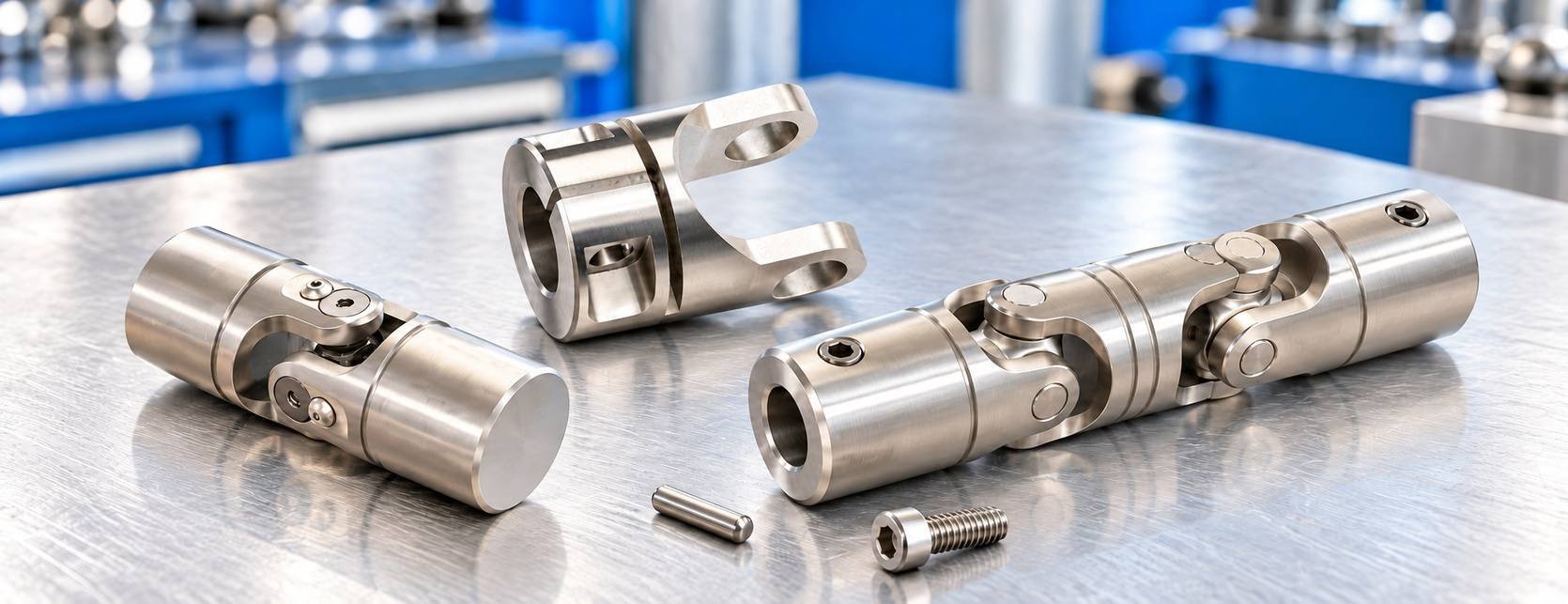
A universal joint, also known as a Cardan joint, is a mechanical component that transmits rotary motion and torque, or turning moment, between two shafts set at an angle to one another. In the conventional design, motion is transmitted through two yokes connected by a cross, which allows the joint to articulate during rotation.
The reliability of the transmission also depends on how each yoke is secured to its shaft. The connection must transmit torque and prevent unwanted axial movement: these functions may be performed by the same element or shared between pins, screws and profiled connections, depending on the design of the hub, the part of the yoke that receives the end of the shaft.
Operation and connection selection
When operating at a non-zero angle, a single universal joint produces a periodic variation in the speed of the driven shaft, even when the driving shaft rotates at a constant speed.
This irregularity increases as the operating angle increases and must be taken into account when selecting the transmission. Using two joints can compensate for it, provided that specific geometric conditions are met: equal operating angles and correct alignment of the yokes on the intermediate shaft.
Sizing must therefore take account of torque, rotational speed and operating angle, as well as starts, shocks and reversals of rotation. The same conditions affect the shaft-to-hub connection, whose capacity must be checked alongside that of the joint.
Selecting the fastening method starts with identifying how torque is transmitted. On a cylindrical shaft without a key, the connection can be made using a pin inserted through dedicated cross holes or through the frictional grip of a clamping hub. With a key or a splined profile, torque is instead transmitted through the mating surfaces of the positive connection; an additional element may be required to maintain the axial position. In keyed connections, for example, a grub screw can provide this axial retention.
Transverse pins and mating holes
A pin passing through the hub and shaft can provide both torque transmission and axial retention. In a diametral through-pin connection, the load generally acts across two shear sections of the pin, located at the interfaces between the shaft and hub.
However, the strength of this connection in a universal joint also depends on the components through which the pin passes. The hole diameter must be appropriate for the shaft cross-section, while the hub walls must contain enough material to withstand the bearing pressures exerted by the pin. Selection therefore concerns the complete assembly, not just the strength of the fastener.
Where specified in the design, coiled spring pinsare retained by the radial pressure they exert within the hole and retain useful flexibility under dynamic loads. Their diameter and duty must be selected according to the loads and the materials of the shaft and hub.
The holes in the hub and shaft must also be aligned and have compatible diameters: excessive differences between these diameters can allow relative movement, while inadequately supported sections of the pin may be subjected to bending. These connecting pins must be distinguished from the internal pivot pins of the joint, which require specific assembly and retention procedures.
Grub screws, screws and clamping hubs for universal joints
Hex socket grub screwsact through a radial threaded hole in the hub, bringing their tip into contact with the shaft.
The point shape determines the type of contact: a cup point may indent the surface, whereas a cylindrical dog point can engage a prepared recess. Selection must therefore take account of the shaft geometry and hardness, as well as the need to remove or reposition the universal joint.
A clamping hub works on a different principle. Tightening the screw reduces the width of the slit, causing the hub to grip the shaft; on a plain cylindrical interface, the resulting contact pressure allows torque to be transmitted by friction. Socket head cap screwsused for clamping must meet the specifications prescribed for the component.
The screw tightening torque and the torque that the hub can transmit are different quantities. The capacity of the connection also depends on tolerances, mating surfaces and shaft insertion depth. Assembly must comply with these parameters and the manufacturer’s instructions.
During operation, noise, vibration or increased play call for an inspection of both the fastenings and the joint mechanism, because wear and inadequate lubrication can compromise even a correctly tightened joint.
Metal sandblasting applied to small metal components: surface preparation, process control and its role in coatings for screws, bolts and threaded parts....
Technical guide to choosing anchors and bolts for air conditioner installation: substrate, bracket, anchoring, vibration, corrosion and proper tightening....
Drywall anchors: types, load capacity, selection criteria and correct installation to identify the most suitable fixing solution for every application....
Industrial automation is now a key factor in improving efficiency, quality, and control in manufacturing processes. By integrating machines, software, and data, companies can make their production more reliable, flexible, and competitive....
Threaded stud bolts are fasteners widely used in industry when it is necessary to ensure strong, reliable and above all time-demountable connections. Unlike traditional screws, they have a specific configuration that makes them particularly suitable ...
Carburizing is a thermochemical treatment that significantly improves steel performance by increasing surface hardness without compromising internal toughness. It is a fundamental solution for components subject to wear, friction and dynamic loads....
Surface treatments of steel are essential to ensure corrosion resistance, durability and reliable performance. Understanding which ones to choose and when to apply them helps you avoid problems, reduce costs, and improve component efficiency....
 Added to quote