Plastic fasteners: benefits and applications in fastening systems
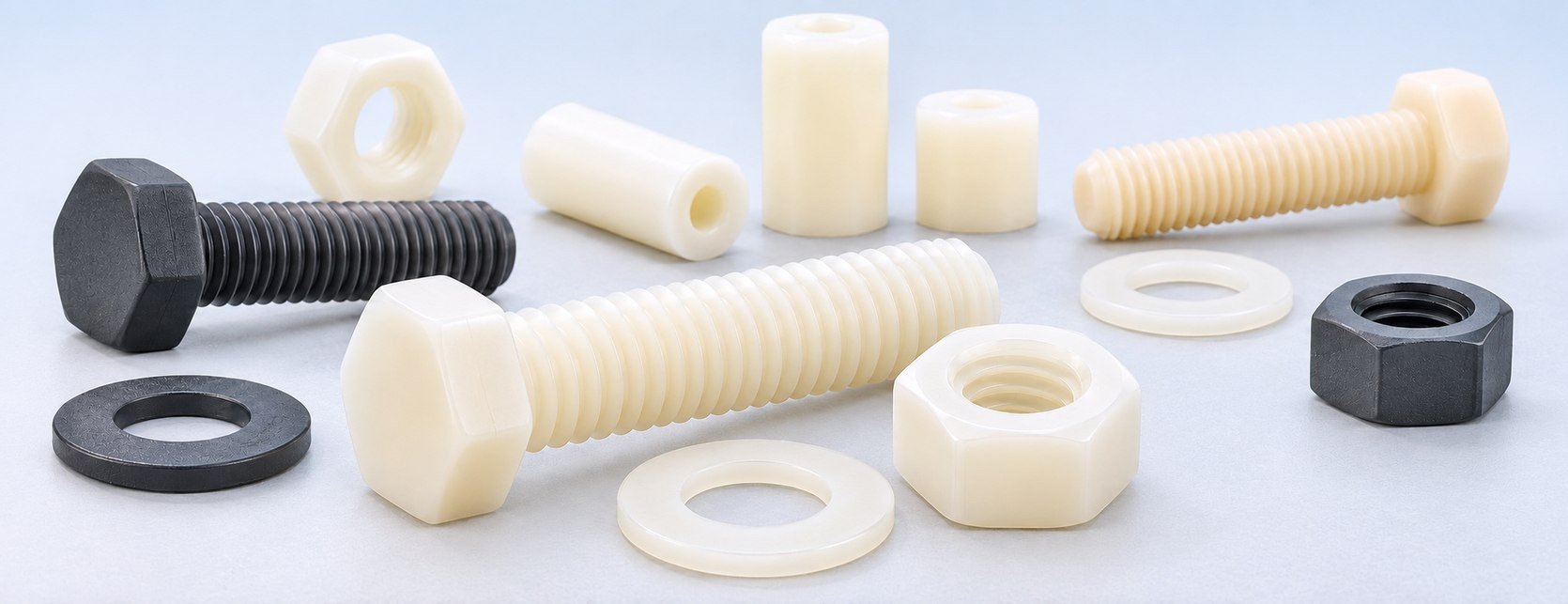
Plastic fasteners include screws, nuts and fastening accessories made from materials such as nylon and other engineering polymers, that is, plastics selected for their mechanical, thermal and electrical properties. These components can be used to form lightweight joints, electrically insulate assembled parts or withstand contact with specific chemicals.
Each material offers different performance characteristics: selecting the right fastener requires an assessment of the load it must withstand, the operating temperature and the environment in which it will be used.
Materials and properties of plastic fasteners
Polyamides PA6 and PA66, commonly known as nylon, combine mechanical strength, wear resistance and toughness, meaning the ability to absorb energy before fracturing. However, they absorb moisture from the environment: water causes dimensional increases and reduces stiffness, making the material more flexible and also changing its insulating properties. These changes must be considered, particularly where the fit requires small clearances or precise dimensions.
POM, or polyoxymethylene, is used in plastic fasteners for its stiffness and low water absorption, which helps limit moisture-induced dimensional changes. Polypropylene, or PP, is distinguished by its low density, which helps reduce weight, and its resistance to many chemicals.
PEEK (polyether ether ketone) is used when mechanical strength must be combined with the ability to operate at temperatures above those tolerated by many common polymers.
Various polymers, including polyamides and PEEK, are also available in formulations reinforced with glass fibre, which increase stiffness and can reduce progressive deformation under load compared with the unreinforced material. The actual properties must be checked in the component’s technical data sheet.
Industrial applications: insulation, low weight and chemical resistance
In electrical engineering and electronics, screws, nuts and spacers made from insulating polymers allow components to be secured without creating an electrical connection through the fastener itself. They are used, among other applications, to mount circuit boards and small panels inside equipment. Spacers also maintain the specified distance between the circuit board and its support.
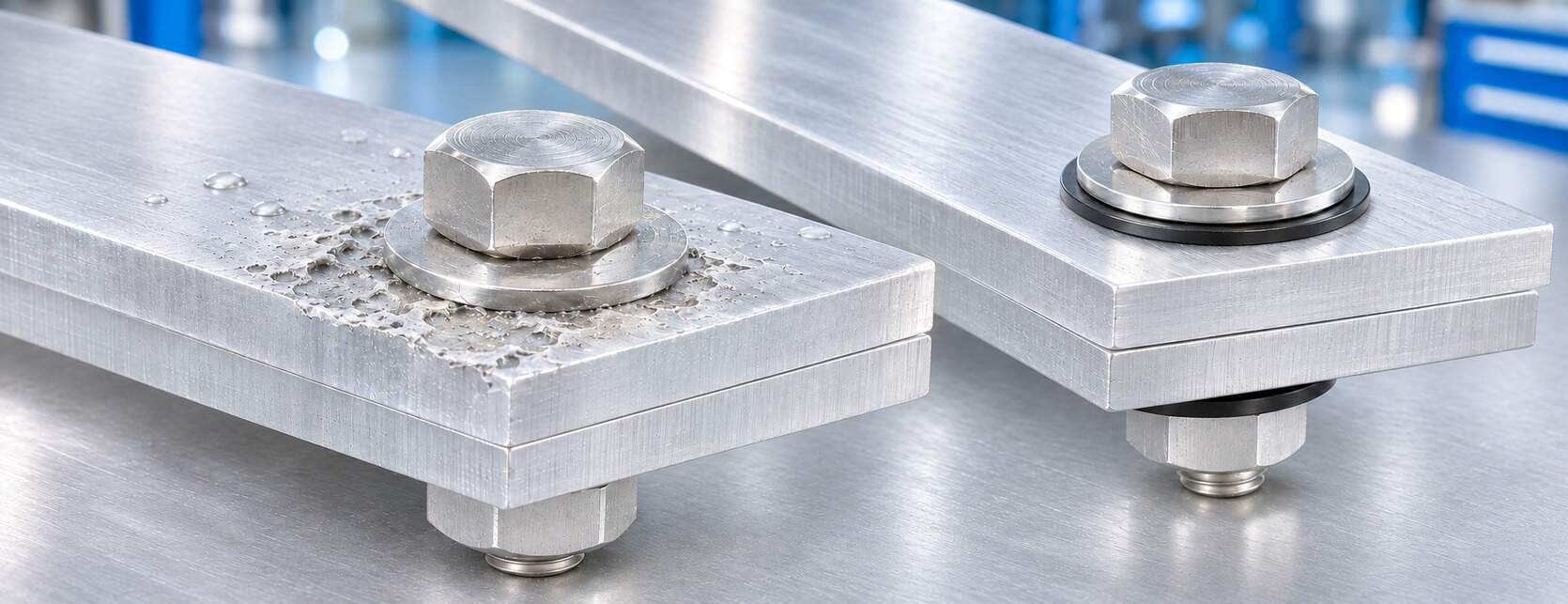
In chemical processing equipment, these fasteners can replace metal ones in environments where the metal is susceptible to corrosion. The benefit depends on selecting a polymer that can withstand the substances with which it will come into contact.
Its compatibility must therefore be checked against the type of substance, its concentration, the temperature and the duration of exposure: a material suitable for a dilute solution may be unsuitable under more aggressive conditions.
Another advantage of plastic fastenersis the reduced weight of joints, owing to the generally lower density of polymers compared with the metals used in fasteners. This benefit can also be achieved using familiar geometries: fully threaded hex-head screws, for example, are also available in plastic in our catalogue.
Fastener sizing and tightening: long-term behaviour
Under a constant load, a polymer component can deform progressively over time. A screw under tension can continue to elongate even if the applied load remains unchanged. This phenomenon is called creep, or time-dependent deformation under sustained load.Stress relaxation, by contrast, occurs when the force developed by the material decreases while its deformation remains approximately constant.
In tightened joints, these behaviours can cause a loss of preload, meaning the initial force that compresses the assembled parts against one another, even without the fastener rotating loose.
When sizing plastic fasteners, it is therefore necessary to assess the magnitude of the stresses, their duration and the operating temperature. Strength values obtained from short-term tests must be supplemented with data on the material’s behaviour under load over time. This assessment makes it possible to check both the expected deformation and the joint’s ability to retain a clamping force appropriate to its function.
In assemblies that include metal parts, differences in the thermal expansion of the materials must also be considered. During heating and cooling, the screw and the connected components may change dimensions to different extents, altering the preload. This effect must be assessed across the entire assembly, particularly where repeated thermal cycles are expected.
Another parameter to consider is the pressure on the bearing surfaces. Distributing the same force over a larger area reduces local stresses and helps limit deformation of the underlying material. Flat washerscan help achieve this. In polymer versions, however, the washer also contributes to the joint’s deformation behaviour and must be assessed under the intended load.
The tightening torque must achieve the required preload without damaging the threads or causing the screw to break. Its value must be established using the manufacturer’s guidance and verified in the application, using suitable torque-controlled tools.
The permissible maximum temperature must also relate to the fastener under its actual operating conditions: the limit specified for the resin alone does not automatically correspond to the temperature that an installed, loaded screw can withstand.
Tumbling of small metal parts: abrasives, process parameters and checks to remove burrs, finish surfaces and maintain geometry and dimensional tolerances....
Metal sandblasting applied to small metal components: surface preparation, process control and its role in coatings for screws, bolts and threaded parts....
Technical guide to choosing anchors and bolts for air conditioner installation: substrate, bracket, anchoring, vibration, corrosion and proper tightening....
Drywall anchors: types, load capacity, selection criteria and correct installation to identify the most suitable fixing solution for every application....
 Added to quote