Close x
X

Sealing Rings: Everything You Need to Know

Sealing Rings: Everything You Need to Know


Sealing rings are mechanical elements designed to accommodate nuts and bolt heads. With a circular and flat structure, DIN 7603 sealing rings are mainly used as spacers in mechanical assemblies and distribute the load evenly over a large surface. In this article, we will define the characteristics of such elements and the various fields in which they are used.

DIN 7603 Sealing Rings


Widely used in the automotive sector, in the construction of turbochargers, electrical systems, and earth-moving machines, DIN 7603 sealing rings are components capable of reducing the risk of surface damage caused by other threaded elements.

This particular type of washer finds application in all the sectors mentioned above because it guarantees good resistance to high temperatures and corrosion.

Below, we summarize the main reasons for choosing to use a DIN 7603 sealing ring:

  • Regulate distance on fastening elements;

  • Provide a durable and reliable seal;

  • Maintain the seal under pressure;

  • Protect from external damage;

  • Achieve simultaneous sealing and locking;

  • Seal fluids such as oil and fuel;

  • High-pressure resistance;

  • Prevent nuts and bolts from rotating and slipping;

  • Even distribution of nut pressure on the surface.

How Many Types of DIN 7603 Sealing Rings Are There?


DIN 7603 sealing rings are mainly available in the following versions:

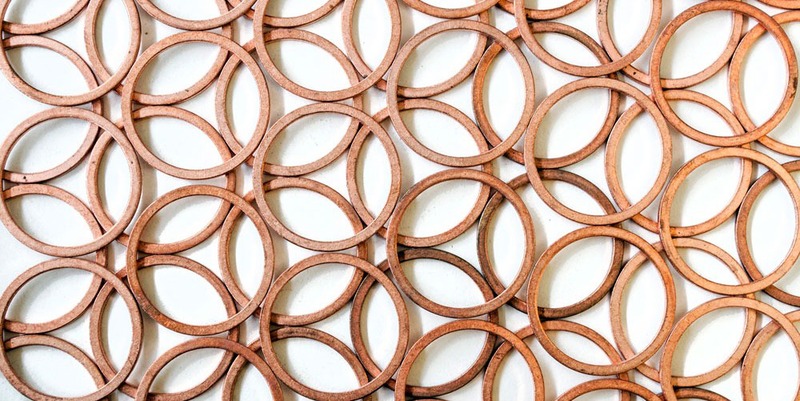
  • Copper rings, which have very high corrosion resistance. These products undergo a special preheating treatment that softens the metal, making it easier to insert into irregular areas of assemblies. Due to this characteristic, they are used in various sectors, except in areas where there is exposure to strong acids.

  • Aluminum rings, like copper products, this second type is applicable in various sectors and is corrosion-resistant. Aluminum indeed offers good corrosion resistance.

The choice of the right ring will therefore depend on the final destination and the type of assembly. In any case, it is advisable to rely on experienced suppliers capable of indicating the most suitable element for different needs.

What Is an O-Ring?


O-rings, commonly named for their circular shape, appear as "crushed washers" due to their minimal thickness.

These products are lightweight, corrosion-resistant, and more durable than a rubber element. Given their versatility of use and the benefits derived from their application, these rings are used in various sectors and workplaces.

From repair workshops, to the maintenance of industrial machinery, to companies dedicated to unique transport, the rings provide resistance and solidity even in the most difficult applications. Moreover, thanks to their high conductive capacity, these elements are used in particular sectors like hydraulics, fuel and oil pipelines, in screw connections in the engine block and cylinder heads, in diesel engines, injector units, hydraulic systems, and motor pumps.

Thus, it is a spacer that, in every application, manages to maximize performance and ensure a solid seal of the assembly over time.

How Do You Measure an O-Ring?


To choose the best product, it is important to select one of the right size and measure.
The measurements of an o-ring result from the value of the cross-section and the inside diameter. A caliper is certainly a useful tool in this regard, capable of providing the correct dimensions of the element.

Difference Between Sealing Rings and O-Ring Gaskets


Although both elements are commonly called "o-rings" for their circular ring shape, it is important to emphasize that sealing rings and o-ring gaskets are two different products.

Indeed, gaskets are rubber or elastomer rings used in mechanics as seals or, precisely, as gaskets. Unlike DIN 7603 sealing rings, which distribute the load evenly, as already mentioned, gaskets are inserted between the parts to be assembled and are compressed during assembly to ensure the seal.

For more information on sealing rings, subscribe to our newsletter.

Contact us at commerciale@univiti.it to receive a free quote.

These categories are mentioned in the article

Latest articles from our blog

The 7 Principles of ISO Family Quality

The 7 Principles of ISO Family Quality

The seven principles of quality form the basis of ISO management systems and, in particular, the ISO 9001 standard. Understanding them means understanding how organizations can improve processes, decisions, and relationships to ensure quality and lon...

Read more ...
Machinery Directive 2006/42/EC: what it really provides and why it is still central to business

Machinery Directive 2006/42/EC: what it really provides and why it is still central to business

The Machinery Directive 2006/42/EC is one of the pillars of European industrial safety and defines the essential requirements that a machine must comply with to be placed on the Union market. It is not a simple formal fulfillment, but a system of res...

Read more ...
Towards a new ISO 9001: the 2026 revision

Towards a new ISO 9001: the 2026 revision

The new revision of ISO 9001 scheduled for 2026 introduces targeted updates on leadership, risk management, digitalization, and sustainability. This long-awaited evolution reinforces the strategic role of quality in modern organizations....

Read more ...
ISO: What It Is?

ISO: What It Is?

ISO certification is a document that certifies the compliance of business processes and management systems with specific standards described in technical regulations. In particular, it serves to ensure that the company operates according to procedure...

Read more ...
DIN 933, 934 e 125: characteristics, differences, and applications of the main bolting standards

DIN 933, 934 e 125: characteristics, differences, and applications of the main bolting standards

The DIN 933, DIN 934, and DIN 125 standards represent three fundamental pillars in the world of screws and bolts. In this article, we analyze their characteristics, differences, and areas of application to understand how standardization guarantees sa...

Read more ...
CBAM and industry: beyond compliance, towards new supply chain choices

CBAM and industry: beyond compliance, towards new supply chain choices

The CBAM is reshaping the relationship between regulation, the market, and the industrial supply chain. In addition to technical aspects, this new regulation raises strategic questions about transparency, data, and supply relationships. After clarify...

Read more ...
Hexagon socket set screws

Hexagon socket set screws

Often invisible, yet essential: hex socket set screws make it possible to secure components in a simple and effective way. In this article, we explain what they are, how they work, and the differences between the various tip types....

Read more ...
Allen srews: everything you need to know

Allen srews: everything you need to know

Compact, durable, and precise: Allen screws are essential in many mechanical applications. A comprehensive guide to understanding types, materials, sizes, and differences compared to hex head screws....

Read more ...
Complete Guide to Bolt Classification According to ISO

Complete Guide to Bolt Classification According to ISO

Over time, classifications and nomenclatures for bolts have been defined to regulate their mechanical and physical characteristics, both at national and international levels. Specifically, the main standards for fasteners are ISO, DIN, and UNI....

Read more ...
Self-Locking Nuts: What Are They and How Do They Work?

Self-Locking Nuts: What Are They and How Do They Work?

In bolted connections subjected to continuous stresses, there is often a serious risk that the nut may loosen from the screw. For this reason, self-locking (or self-braking) nuts have been developed and designed....

Read more ...