Tensile Testing and Screw Strength: How Does It Work?
The wide range of screws available on the market is directly proportional to their possible and different uses. As we have seen in some other articles, the screw is a fastening element that finds a wide range of applications and, for this reason, requires in-depth knowledge.
In fact, to choose the most suitable screw for your needs, you should not only consider the diameter, length, threading, or type of head but also the mechanical characteristics such as the resistance class.
To measure this capacity, tensile tests come into play, which we have dedicated the following paragraphs to understand what they involve.
What is Determined by the Tensile Test?
The tensile test is a conventional test that measures tensile strength, or the breaking resistance, of materials subjected to a process of elongation.
It is therefore a mechanical test conducted on specimens which are subjected to an increasingly high monoaxial load. In other words, the element is subjected to forced deformation with the goal of evaluating its yield load or breaking load.
The test develops through several phases:
Elastic behavior, the 1st phase of the process where the element's configuration is still restorable. Returning the load value to zero, the element will return to its original length;
Yielding, in this 2nd phase the material's behavior is no longer linear and, consequently, an increase in load value corresponds to a slight deformation and a drop in resistance;
Plastic behavior, during the 3rd phase, the deformation becomes increasingly permanent. Indeed, even if the load value is zeroed, the material does not return to its original length;
Necking, in the 4th and penultimate phase, part of the tested element deforms quickly;
Specimen breakage, is the 5th and final phase of the process that occurs when the breaking load is reached.
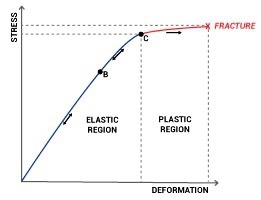
The test results are reported in a stress-strain diagram showing all the steps taken and the material reactions, starting from a null value to a maximum value known as UTS (Ultimate Tensile Strength).
The UTS is the maximum stress applicable to the tested element.
Figure 1. Stress-strain diagram example
Thus, the two crucial points within the diagram and therefore the process are yielding and the breaking load.
In the following paragraphs, we will define in detail what is meant by these terms but, for completeness of information, we wanted to dedicate an in-depth analysis to further screw resistance tests.
Some Screw Resistance Tests
The main reference standards establish the minimum values to be respected for a screw to be considered standard. These values apply to both the physical characteristics of the element – measurable, for example, by using the caliper – and the mechanical characteristics.
Specifically, the latter are used to measure the screw's resistance and can be distinguished in:
Head resistance tests. The test is conducted on an inclined plane where the element's head is subjected to a breaking load relative to its diameter. The test is passed if no breakage of the head occurs;
Hardness tests. The hardness of the screws must be as homogeneous as possible, guaranteeing the use of adequate steels and correct heat treatment. The test is carried out on the surface of the screw or on a section. Using a durometer – a device capable of applying variable and increasing pressure over time – the material is indented and the size of the indentation will be measured: the smaller it is, the harder the material will be.
Microhardness tests. This test, provided for screws that have undergone a surface hardening process, is performed on the surface of the threading and on the section. Applying the same procedures as the hardness test, the test involves the screw being longitudinally sectioned. This examination, for functional reasons, is only carried out on elements with thread pitches greater than or equal to 1.25mm. If the pitch has a different value than indicated, it is not possible to proceed with the hardness test but a microscope analysis is performed.
What is Steel Yielding?
The standard definition of yield load indicates it as the stress that, in reference to the stress/strain diagram, causes a deviation from the initial length.
When a material is subjected to a force of a value lower than its yield load, it deforms but returns to its original shape as soon as the load is removed. Conversely, when the force is greater than the yield load, the material does not return to its original shape.
In general, the yield load varies depending on the material. For example, the yield load of steel is significantly higher compared to that of aluminum.
What Does Breaking Load Mean?
The term unit breaking load refers to the maximum load a material can withstand without breaking. It is thus an external stress greater than the yield load, beyond which the material fractures.
The breaking load, like the yield load, is determined through tensile tests from which different results emerge for different types of materials.
The breaking load is not defined in a uniform way but can vary depending on the mode of application.
For this reason, different tests are carried out to record the material's different behavior based on its final destination. There are therefore different types of tests, including:
Tensile breaking load;
Compressive breaking load;
Bending breaking load;
Torsional breaking load;
Shear stress breaking load.
For further useful information on tensile tests and the values related to them, subscribe to our newsletter.
Drywall anchors: types, load capacity, selection criteria and correct installation to identify the most suitable fixing solution for every application....
Industrial automation is now a key factor in improving efficiency, quality, and control in manufacturing processes. By integrating machines, software, and data, companies can make their production more reliable, flexible, and competitive....
Threaded stud bolts are fasteners widely used in industry when it is necessary to ensure strong, reliable and above all time-demountable connections. Unlike traditional screws, they have a specific configuration that makes them particularly suitable ...
Carburizing is a thermochemical treatment that significantly improves steel performance by increasing surface hardness without compromising internal toughness. It is a fundamental solution for components subject to wear, friction and dynamic loads....
Surface treatments of steel are essential to ensure corrosion resistance, durability and reliable performance. Understanding which ones to choose and when to apply them helps you avoid problems, reduce costs, and improve component efficiency....
In the metal fabrication and construction industries, structural connection and reinforcement systems play a fundamental role in ensuring long-term stability and safety. Among these, steel tension rods are a widely used technical solution for absorbi...
The metalworking sector is one of the pillars of modern industry. But what does it actually encompass? What are its categories, and what jobs fall under it? In this article, we provide a clear and comprehensive analysis of one of the most strategic s...
Behind every product that reaches the market lies a complex network of suppliers, production processes, logistics, and distribution. Supply Chain Management was developed precisely to efficiently coordinate all these activities, transforming supply c...
Heat treatment of steel is one of the most important processes for obtaining reliable, resistant metal components suitable for industrial applications. From normalizing to tempering, these processes modify the structure of the material and determine ...
 Added to quote