Search the more than 56.000 items in the catalog.
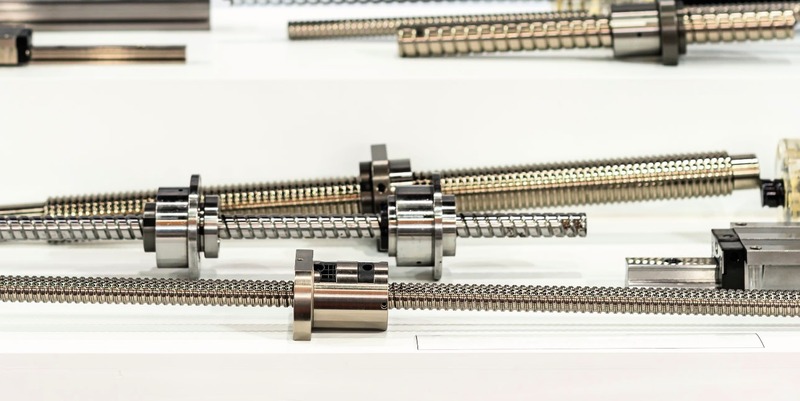
As can be inferred from the name, this thread gets its title from its particular shape. Indeed, the profile of a thread made in this way presents the shape of a symmetric isosceles trapezoid and falls into the class of non-triangular threads. The dimensions of the trapezoidal threads are expressed in millimeters, and the angle formed by the sides of the thread determines a profile angle of 30°.
The main characteristic of this type of thread is found in its capacity to transmit motion and withstand a very high friction coefficient.
This makes a screw with such thread self-locking. This type of threading finds its main field of application in the transmission of relative motion between mechanical organs.
What does this mean? In practice, trapezoidal profile screws are used to transform their rotary or circular motion into linear motion.
Therefore, considering the screw - nut system, through a rotary motion impressed on the screw, a linear translational motion can be obtained on the nut. Trapezoidal screws can thus also be defined as maneuvering screws, since by rotating the screw or the nut, a reciprocal displacement of two mechanical organs can be obtained.
Therefore, to exploit the full potential of such threading, the rotary movements must be converted into translational movements.
Among the range of trapezoidal profile threads, the most widespread and known is the ISO 2901 thread, which ensures the transmission of significant forces and a very high tolerance of movement. In general, the entire range of ISO trapezoidal threads is used for the transmission of significant forces with high levels of precision.
When talking about screws and nuts with trapezoidal threads, we are referring to mechanical items that are used for fastening and for movement.
The fields of application are varied, ranging from DIY to the industrial world. Specifically, the trapezoidal thread finds wide application in production equipment. Below are some examples of industrial applications of screws with trapezoidal threading:
By this point, it will appear clear that the main advantage of using this thread lies in its ability to transmit motion and be, at the same time, self-locking.
Indeed, the threaded part of the screw does not need to be fixed in the desired position, and the transformation of movements, from rotary to translational, occurs with the help of a nut that pushes the component of the nut onto the screw.
Given the high potential of trapezoidal threading, the main advantages deriving from its use are:
For completeness of information, below is the table related to the dimensions for ISO 2901 metric trapezoidal threads: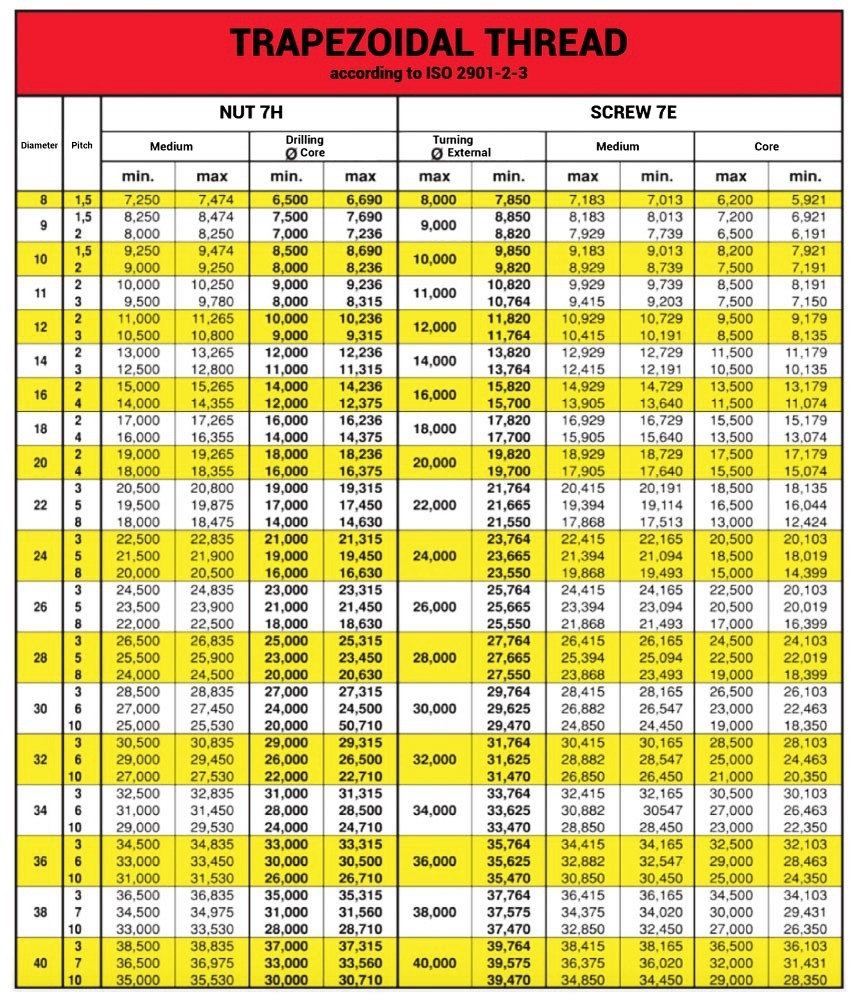
For more useful and interesting information about this product, subscribe to our newsletter. If you want to receive a free quote, contact our commercial team by writing to commerciale@univiti.it
Drywall Anchors: Types, Load Capacity and Selection Criteria
Drywall anchors: types, load capacity, selection criteria and correct installation to identify the most suitable fixing solution for every application....
Read more ...
Industrial Automation: How It Works and What Benefits It Offers to Manufacturing
Industrial automation is now a key factor in improving efficiency, quality, and control in manufacturing processes. By integrating machines, software, and data, companies can make their production more reliable, flexible, and competitive....
Read more ...
Threaded stud bolts: features and applications
Threaded stud bolts are fasteners widely used in industry when it is necessary to ensure strong, reliable and above all time-demountable connections. Unlike traditional screws, they have a specific configuration that makes them particularly suitable ...
Read more ...
Carbocementation: How to Increase the Surface Hardness of Steel
Carburizing is a thermochemical treatment that significantly improves steel performance by increasing surface hardness without compromising internal toughness. It is a fundamental solution for components subject to wear, friction and dynamic loads....
Read more ...
Surface treatments of steel: protection and durability
Surface treatments of steel are essential to ensure corrosion resistance, durability and reliable performance. Understanding which ones to choose and when to apply them helps you avoid problems, reduce costs, and improve component efficiency....
Read more ...
Steel Tension Rods: Types, Sizing, and Structural Applications
In the metal fabrication and construction industries, structural connection and reinforcement systems play a fundamental role in ensuring long-term stability and safety. Among these, steel tension rods are a widely used technical solution for absorbi...
Read more ...
The Metalworking Sector in Italy: What It Is, What It Encompasses, and What Jobs It Includes
The metalworking sector is one of the pillars of modern industry. But what does it actually encompass? What are its categories, and what jobs fall under it? In this article, we provide a clear and comprehensive analysis of one of the most strategic s...
Read more ...
Supply Chain Management: What It Is, How It Works, and Why It Has Become Strategic for Businesses
Behind every product that reaches the market lies a complex network of suppliers, production processes, logistics, and distribution. Supply Chain Management was developed precisely to efficiently coordinate all these activities, transforming supply c...
Read more ...
Heat treatment of steel: what it is, what it is used for, and why it is essential in the fastener industry
Heat treatment of steel is one of the most important processes for obtaining reliable, resistant metal components suitable for industrial applications. From normalizing to tempering, these processes modify the structure of the material and determine ...
Read more ... Added to quote