Locking Nuts: What They Are, What They're Used For, and Types
In the world of mechanical and industrial engineering, locking nuts play a crucial role. These components are essential in numerous applications, from securing roller bearings to creating secure mechanical connections.
In this article, we will explore the different types of locking nuts, highlighting their characteristics and specific uses, and we will delve into locking nuts, explaining what they are and in what contexts they are used.
Locking Nuts: Main Types
There are numerous variants of locking nuts on the market, each with particular characteristics and purposes. Among the main types of locking nuts, we can mention:
Threaded Locking Nuts: characterized by internal or external threads, they screw onto the shaft or component to be fixed, ensuring a precise and resistant assembly;
Self-Locking Nuts: equipped with mechanisms that prevent unscrewing under the action of vibrations or dynamic loads, offering an additional level of safety;
KM Locking Nuts: known for their robustness and ease of assembly. Designed according to precise industrial standards, these nuts fit perfectly with a wide range of bearings, offering a reliable solution for securing rotating components;
Locking Nuts: designed to ensure secure fastening, they prevent axial movement of components on a shaft.
In the Univiti catalog, you can find different types of locking nuts, including:
Each product is suitable for specific uses. In the following paragraphs, we will focus on a particular category of locking nuts, explaining what they are and their main uses.
What Are Locking Nuts?
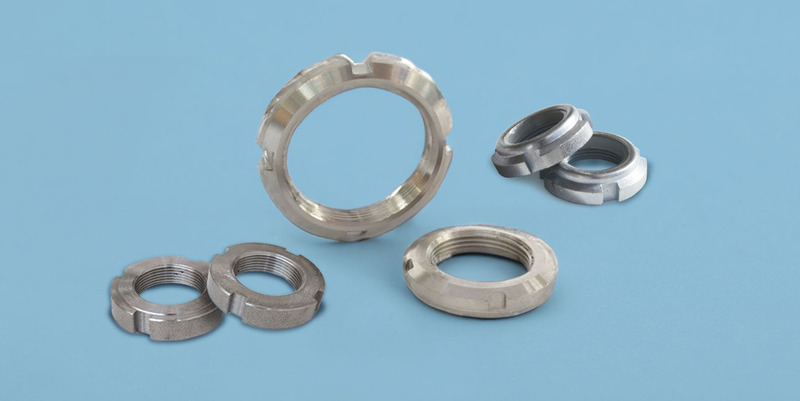
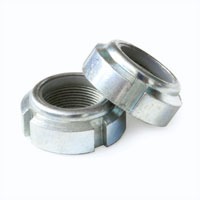
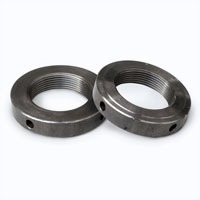
Locking nuts are specifically designed to prevent the unwanted movement of mechanical components along a shaft by firmly locking them in position. They are combined with various fastening mechanisms, including screw clamping systems or friction locking devices, to ensure a secure and reliable connection.
Locking nuts have two main features:
An internal threaded ring
An outer part with a crown that may have a series of variously shaped notches.
Each variant is designed to meet specific mechanical needs, ensuring maximum efficiency and safety. The choice of nut will depend on various factors, such as:
The specific application and the rotation of the shaft (in one or both directions)
Load requirements
Operating conditions
Radial and axial space
Ease and frequency of assembly and disassembly
Proper evaluation is necessary before purchasing the most suitable locking nut.
Main Uses of Locking Nuts
Locking nuts are used in numerous industrial contexts where it is necessary to ensure that components such as bearings, gears, or pulleys remain fixed in a specific position on a shaft.
These components are indispensable in specific cases like:
Machinery operating in high-vibration conditions
Situations where unwanted axial movement could cause failures or malfunctions.
Indeed, the main contexts of application for locking nuts include:
On shaft hubs
As a locking system for ball bearings or as regulators of their movement
Inside carabiners with screw locks
As keyed elements
Their ability to ensure a secure and lasting lock makes these nuts indispensable in a wide range of contexts, from the maintenance of heavy machinery to the construction of vehicles and aerospace equipment.
Choosing the right type of locking nut is crucial for ensuring the longevity and safety of mechanical assemblies.
If you want to learn more about locking nuts, subscribe to our newsletter!
Drywall anchors: types, load capacity, selection criteria and correct installation to identify the most suitable fixing solution for every application....
Industrial automation is now a key factor in improving efficiency, quality, and control in manufacturing processes. By integrating machines, software, and data, companies can make their production more reliable, flexible, and competitive....
Threaded stud bolts are fasteners widely used in industry when it is necessary to ensure strong, reliable and above all time-demountable connections. Unlike traditional screws, they have a specific configuration that makes them particularly suitable ...
Carburizing is a thermochemical treatment that significantly improves steel performance by increasing surface hardness without compromising internal toughness. It is a fundamental solution for components subject to wear, friction and dynamic loads....
Surface treatments of steel are essential to ensure corrosion resistance, durability and reliable performance. Understanding which ones to choose and when to apply them helps you avoid problems, reduce costs, and improve component efficiency....
In the metal fabrication and construction industries, structural connection and reinforcement systems play a fundamental role in ensuring long-term stability and safety. Among these, steel tension rods are a widely used technical solution for absorbi...
The metalworking sector is one of the pillars of modern industry. But what does it actually encompass? What are its categories, and what jobs fall under it? In this article, we provide a clear and comprehensive analysis of one of the most strategic s...
Behind every product that reaches the market lies a complex network of suppliers, production processes, logistics, and distribution. Supply Chain Management was developed precisely to efficiently coordinate all these activities, transforming supply c...
Heat treatment of steel is one of the most important processes for obtaining reliable, resistant metal components suitable for industrial applications. From normalizing to tempering, these processes modify the structure of the material and determine ...
 Added to quote