The term "threads" refers to connection systems that allow different elements to be assembled together. A thread consists of a helix that winds on an external conical or cylindrical surface of the screw or on the internal surface of a similar element, hence the nut.
These two elements, screw and nut, can be described as a movable coupling because they can be disassembled and reassembled without deteriorating the parts.
There are several types of threads that are important to know and distinguish in order to choose the right hardware product and apply it correctly.
How many types of threads exist? How are they recognized?
For a good understanding of the different coupling possibilities between screw and nut, the starting point is the knowledge of the types of threads and their designation. Each thread is distinguished by the different elements that characterize it. Specifically, these are:
Length, measured in relation to the axis of the screw or nut;
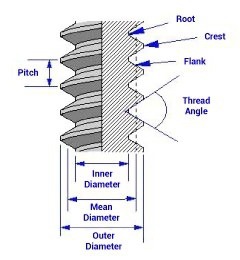
Nominal diameter of the thread, in reference to the characteristic diameters of the threads such as the external diameter (De), the core diameter (Dn), and the mean diameter (Dm) obtained by adding the first two;
Height, obtained by calculating the difference between De and Dn;
Thread pitch, a factor measured with a tool called a thread gauge;
Direction of the helix, whether the threading is clockwise or anticlockwise and therefore whether it is a right-handed or a left-handed thread;
Helix angle, which describes the geometric shape of the thread;
Crest or Vertex, the upper surface that joins the two sides;
Root or Bottom, the lower surface that joins the two sides;
Flanks, the lateral surface located between crest and root.
Below is an explanatory image of the characteristics just listed.
Based on the aforementioned characteristics, the standard and most common thread shapes can be distinguished into two main types:
Triangular threads
Non-triangular threads.
The triangular thread is usually used as a connection. The angle between the threads is 60° while the crest can be flat or rounded. Among the most used triangular thread systems is the ISO metric thread, the classic screw identified by an M with an ideal profile equivalent to an equilateral triangle, and the Gas thread, a coupling that guarantees sealing in the passage of fluids and is indeed used in gas pipelines.
As for non-triangular threads, the most common forms are:
Unlike the triangular thread, these two systems are not primarily used as a connection but for power transmission. For example, trapezoidal threads can undergo numerous modifications without sacrificing the efficiency of the element. The angle between the threads can vary from 10° to 15°, thus reducing the space between the teeth.
Types of Threads and Their Designation
The different types of threads are distinguished not only by their specifics but also by their designation. The way a thread is indicated and, therefore, its designation, is distinguished by some elements:
Lateral symbol, which identifies the thread;
Nominal diameter (corresponding to the external diameter of the screw, measured in inches or millimeters, or to a conventional diameter in Gas threads);
Pitch (measured in millimeters when it differs from the nominal diameter);
Number of starts (expressed when it is greater than one, it refers to the number of parallel and independent threads present on the surface of the screw);
Direction of the helix (if left or LH, Left Hand).
For example, the designation "M 16 x 1.5 left" indicates: ISO metric thread with a triangular profile, nominal diameter of 16 mm, left helix, and fine pitch. But, in detail, what is meant by fine pitch and coarse pitch? What is the difference between these two nomenclatures?
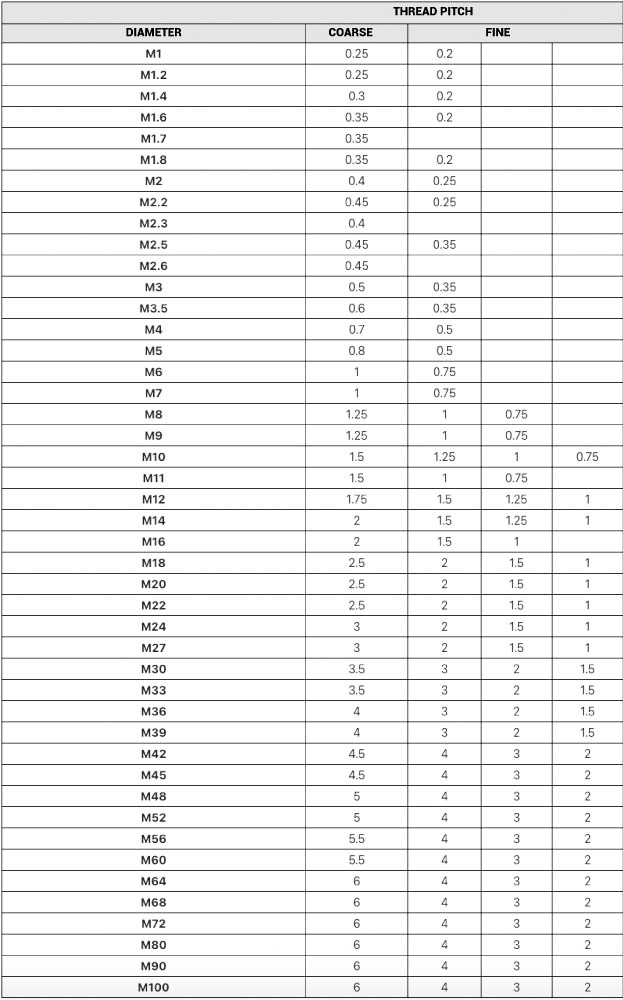
Coarse and Fine Thread Pitches: Summary Table
Among the values indicated in the designation, there are precisely the thread pitches. In essence, the thread pitch is the distance between two consecutive threads of the same helix, thus between the grooves of the screw, and is found in the ISO metric thread. The ISO metric thread is the standard thread recognized by the International Organization for Standardization and has a triangular profile and an angle, of profile, of 60°. The threads of screws produced according to this metric are identified with an M. This letter may be followed by a value, expressed in mm, when the thread is a fine pitch. Indeed, there are two types of pitches: coarse and fine.
The coarse pitch thread is the one with the standard nominal diameter that ensures sealing against unscrewing. To this series corresponds a single pitch value and the adjective "coarse" indicates that such pitch is the one with the higher value for that diameter. The fine pitch thread is used for special applications such as, for example, when a higher anti-unscrewing capacity is required, or a greater fluid sealing capacity, or when a very precise screwing adjustment is needed. Fine pitch threads can be found in several sizes for the same diameter.
Below is a summary table of diameters and corresponding thread pitches.
To not miss other articles like this and receive more information on thread types, subscribe to our newsletter.
Drywall anchors: types, load capacity, selection criteria and correct installation to identify the most suitable fixing solution for every application....
Industrial automation is now a key factor in improving efficiency, quality, and control in manufacturing processes. By integrating machines, software, and data, companies can make their production more reliable, flexible, and competitive....
Threaded stud bolts are fasteners widely used in industry when it is necessary to ensure strong, reliable and above all time-demountable connections. Unlike traditional screws, they have a specific configuration that makes them particularly suitable ...
Carburizing is a thermochemical treatment that significantly improves steel performance by increasing surface hardness without compromising internal toughness. It is a fundamental solution for components subject to wear, friction and dynamic loads....
Surface treatments of steel are essential to ensure corrosion resistance, durability and reliable performance. Understanding which ones to choose and when to apply them helps you avoid problems, reduce costs, and improve component efficiency....
In the metal fabrication and construction industries, structural connection and reinforcement systems play a fundamental role in ensuring long-term stability and safety. Among these, steel tension rods are a widely used technical solution for absorbi...
The metalworking sector is one of the pillars of modern industry. But what does it actually encompass? What are its categories, and what jobs fall under it? In this article, we provide a clear and comprehensive analysis of one of the most strategic s...
Behind every product that reaches the market lies a complex network of suppliers, production processes, logistics, and distribution. Supply Chain Management was developed precisely to efficiently coordinate all these activities, transforming supply c...
Heat treatment of steel is one of the most important processes for obtaining reliable, resistant metal components suitable for industrial applications. From normalizing to tempering, these processes modify the structure of the material and determine ...
 Added to quote